
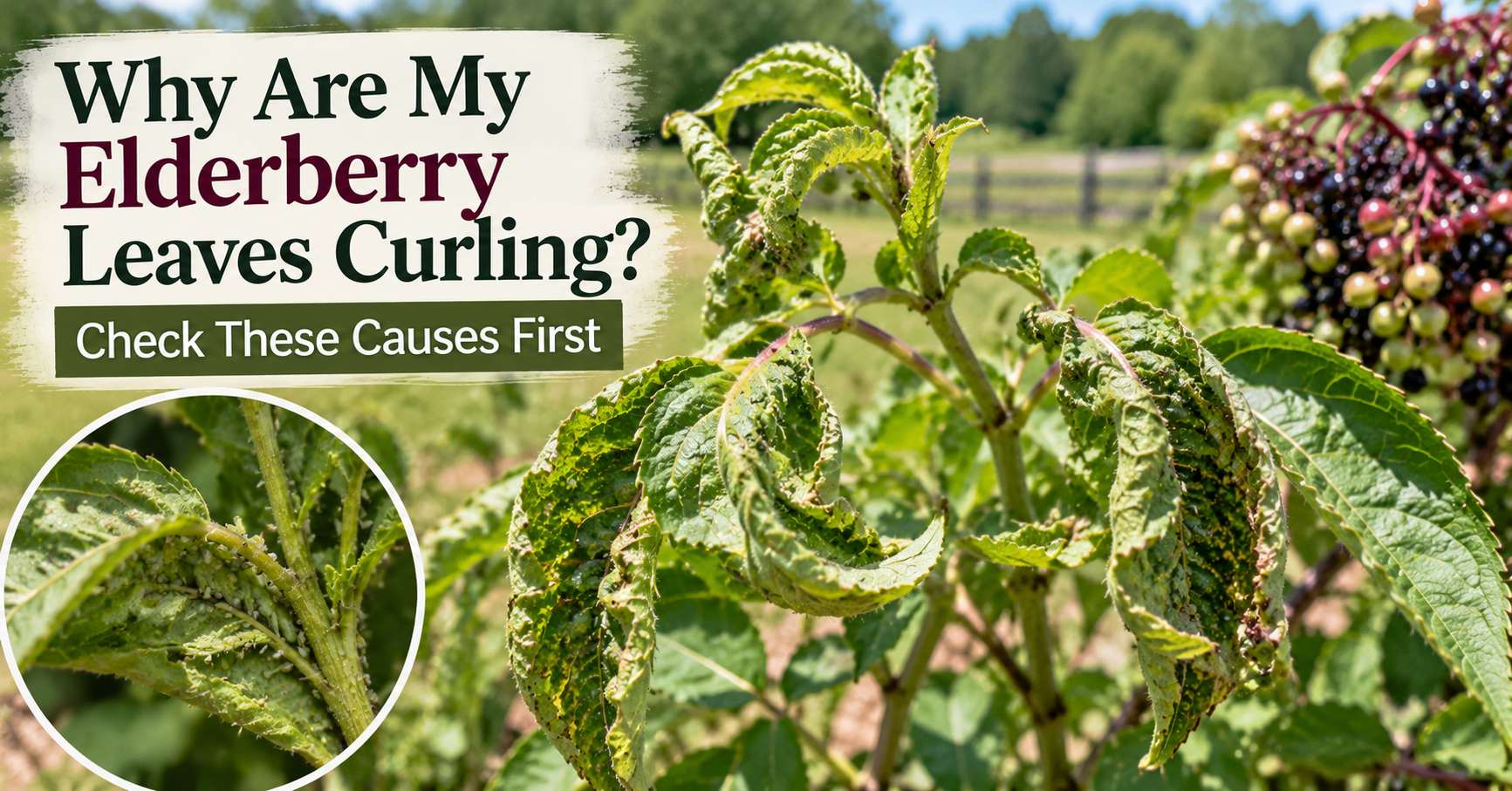
Curled elderberry leaves are one of those symptoms that can send you down the wrong path pretty quickly.
The leaves look wrong.
Maybe they’re curling inward.
Maybe the newest growth looks twisted and crinkled.
Maybe the edges are rolling.
Or maybe entire leaves look puckered like they never unfolded correctly.
The temptation is to immediately fertilize, water, or spray something.
I wouldn’t.
The first thing I’d do is turn over several curled leaves and look closely at the newest growth.
What you find there can completely change what you should do next.
Elderberry leaf curl can come from tiny mites, aphids, water stress, herbicide exposure, nutritional problems, and other forms of plant stress.
The shape of the damage and what else is happening on the plant are much more useful than the word “curling” by itself.
Why Are My Elderberry Leaves Curling?
The causes I’d investigate first are:
- Eriophyid mites.
- Aphids.
- Water stress.
- Herbicide drift or accidental herbicide exposure.
- Nutrient problems.
- Other insect or disease damage.
I wouldn’t treat all six at once.
Instead, use the appearance of the leaves and what’s happening around the plant to narrow the list.
That’s how you avoid treating mites with fertilizer or trying to fix herbicide injury with extra water.


Start With the Newest Leaves
Where the curling occurs tells you something.
If the newest growth is emerging crinkled, puckered, tightly curled, or distorted while older leaves look relatively normal, I’m particularly interested in pests or something interfering with that developing tissue.
Young leaves are soft.
They’re actively expanding.
Damage occurring while they’re developing can leave them permanently distorted even after the original problem changes.
That’s why I don’t expect an already twisted leaf to magically flatten into a perfect leaf later.
What I really want to see is healthy new growth after the underlying problem improves.

Cause 1. Eriophyid Mites
This is one of the first things I’d investigate on elderberries with distinctly curled or puckered new leaves.
Eriophyid mites are incredibly small.
You’re not necessarily going to turn over a leaf and immediately see a bunch of obvious bugs crawling around.
Their damage can be much easier to notice than the mites themselves.
Missouri Extension specifically documents eriophyid mites causing inward leaflet curling on elderberry.
They can also produce stunted leaflets with noticeable puckering between the veins.
That’s a pretty specific clue.
If my elderberry has distorted, crinkled new foliage that looks like it never expanded correctly, mites move high on my suspect list.
What Eriophyid Mite Damage Looks Like
Look for:
Inward curling.
Crinkled leaves.
Puckering.
Stunted leaflets.
Distorted new growth.
In heavier cases, the newest foliage can look dramatically different from normal elderberry leaves farther down the cane.
This is where comparing leaves on the same plant becomes useful.
Find an older healthy leaf.
Then hold it beside the distorted new growth.
The difference can be striking.

Mites Can Overwinter on the Elderberry
This is another reason the problem can seemingly return.
Eriophyid mites can overwinter around bud scales on the plant.
That means this isn’t necessarily an insect that randomly flew into your yard yesterday.
A plant with a recurring mite problem may carry the issue from one growing season into the next.
Missouri Extension’s elderberry pest-management guidance specifically addresses eriophyid mites during dormant and pre-bloom periods.
For a backyard grower, that reinforces something important:
Timing matters.
Once leaves are badly curled and distorted, you’re looking at damage that’s already happened.
Don’t Automatically Reach for a Broad-Spectrum Insecticide
Tiny pest equals spray everything?
Not necessarily.
Eriophyid mites also exist within a larger ecosystem that includes predatory mites and other beneficial organisms.
Broad-spectrum pesticide use can kill beneficial predators along with the pest you’re targeting.
That’s why I prefer identifying the problem and using current Extension guidance rather than grabbing whatever insecticide happens to be in the garage.
If the infestation is severe or recurring, your local Extension office can help confirm the diagnosis and recommend management appropriate for your area.



Cause 2. Aphids
Aphids are much easier to understand once you’ve actually seen them.
These small sap-feeding insects often congregate on tender new growth and the undersides of leaves.
Their feeding can cause leaves to curl, pucker, yellow, and become distorted.
Oklahoma State specifically lists aphids as an elderberry pest and notes that their feeding may produce distorted foliage.
So if the leaves are curling, I turn them over.
Look closely.
Especially around tender shoots.
The Sticky Clue That Points Toward Aphids
One of my favorite diagnostic clues is stickiness.
Aphids produce a sugary waste product called honeydew.
That can leave foliage feeling sticky.
Ants may also become unusually interested in the plant because they’re attracted to that honeydew.
So:
Curled leaves + clusters of tiny insects + sticky foliage + ants
makes aphids much more convincing than simply seeing curled leaves alone.
You may also eventually notice dark sooty mold growing on honeydew-coated surfaces.
Again, the extra clues matter.



What Should You Do About Aphids?
For a small infestation, I don’t necessarily need to escalate immediately to pesticides.
A strong stream of water can knock aphids from sturdy plants.
Infested shoots can sometimes be pruned out.
Lady beetles, lacewings, syrphid fly larvae, parasitic wasps, and other beneficial insects also feed on aphids.
That’s another reason I don’t want to destroy every insect in the garden because I found one pest.
If an insecticidal product becomes necessary, I’d use something actually labeled for the intended use and follow the label rather than improvising a homemade chemical cocktail.
Cause 3. Drought Stress
Now put the bugs aside for a moment.
Leaves can also curl because the plant is struggling with water.
During hot, dry conditions, curling or rolling leaves can reduce exposed leaf surface and accompany other signs of stress.
This is where I check the soil instead of guessing.
Don’t look at curled leaves and automatically decide:
Water it.
Stick your finger into the soil.
Dig a little.
See what’s actually happening around the root zone.
If it’s genuinely dry and the plant has been dealing with prolonged heat, drought stress becomes much more plausible.

Too Much Water Can Cause Problems Too
This is why “just water it” isn’t a diagnosis.
Elderberries enjoy moisture, but roots still need oxygen.
Constantly saturated soil and poor drainage can stress the root system.
A root system that isn’t functioning properly can create symptoms above ground even though the soil looks wonderfully wet.
If the ground is already soaked, adding another five gallons because the leaves look strange isn’t necessarily helping.
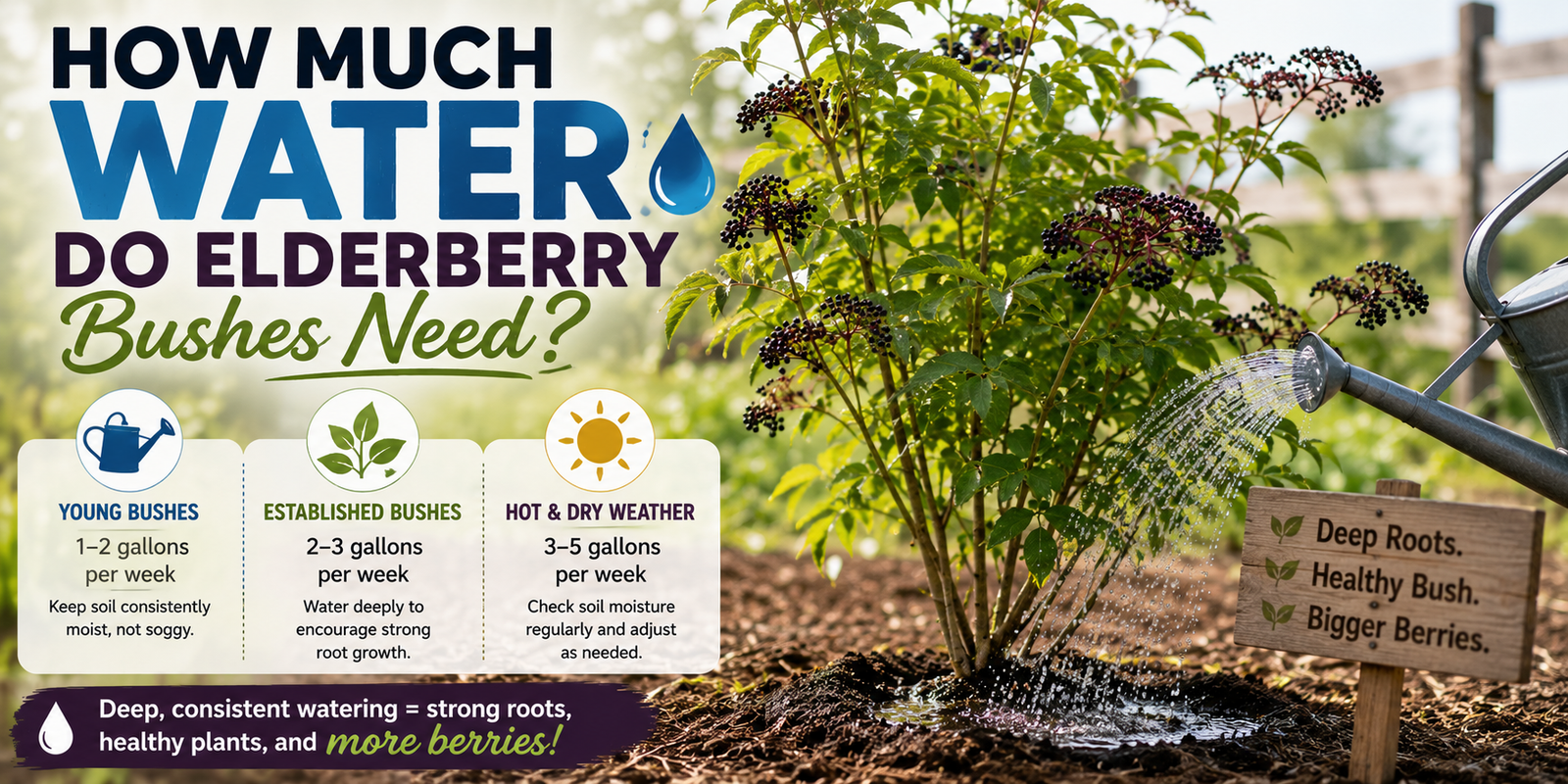
For the full watering question, use How Much Water Do Elderberry Bushes Need? rather than trying to solve every moisture issue from leaf curl alone.
This article is about identifying the curl.
That one is about getting watering right.
Cause 4. Herbicide Drift
This is the cause I think many gardeners completely miss.
You may never have intentionally sprayed the elderberry.
That doesn’t mean herbicide exposure is impossible.
Products containing growth-regulator herbicides such as 2,4-D can injure sensitive broadleaf plants through drift or volatilization.
Elderberries can show dramatic distortion.
Twisted leaves.
Cupping.
Strap-like growth.
Abnormally shaped new foliage.
And sometimes the damage is so strange that people assume the plant has developed a bizarre disease.
Your Lawn Treatment Can Matter
Think beyond the elderberry bed.
Was the lawn recently treated?
Did you use weed-and-feed?
Did someone spray broadleaf weeds nearby?
Was it windy?
Was it hot?
Did a neighboring property receive treatment?
Extension specialists have documented elderberry damage consistent with 2,4-D-type herbicide exposure even when the product wasn’t sprayed directly onto the elderberry.
That means the timeline matters.
If your elderberry suddenly develops bizarre twisted new growth shortly after nearby weed control, herbicide injury belongs on the list.
Herbicide Damage Often Looks Different From Simple Wilting
Water stress often makes me think about drooping or rolling foliage.
Herbicide injury can create growth that looks deformed.
Leaves may twist into strange shapes.
New growth can look narrow or strap-like.
Veins can appear unusually prominent.
The entire growing tip may look wrong.
If multiple sensitive broadleaf plants nearby suddenly develop similar distortion, that strengthens the herbicide-drift possibility.
Look at tomatoes.
Grapes.
Redbuds.
Other broadleaf plants.
Sometimes your elderberry isn’t the only thing telling you something happened.
Don’t Try to Cure Herbicide Damage With Fertilizer
This is another example of why diagnosis matters.
If herbicide exposure damaged the developing tissue, dumping fertilizer around the plant isn’t an antidote.
Neither is overwatering.
The first step is preventing additional exposure.
Then support the plant with otherwise appropriate growing conditions and watch what subsequent growth does.
The severity of the injury will influence how well the plant recovers.
Cause 5. Nutrient Problems
Nutrition can contribute to abnormal foliage, but I put this lower on my list than many gardeners do.
Why?
Because fertilizer is easy to reach for.
Someone sees ugly leaves and assumes:
The plant needs food.
Maybe.
But maybe not.
Nutrient deficiencies and excesses can both create symptoms.
That’s why blindly adding more fertilizer can occasionally make the situation worse.
Look at the entire plant.
Look at leaf color.
Look at which leaves are affected first.
Think about what you’ve already applied.
And if nutrient problems genuinely seem likely, a soil test gives you far more useful information than guessing.
Curling Plus Yellow Leaves Changes the Diagnosis
If your elderberry leaves are both curling and turning yellow, the yellowing becomes another important clue.
Now I’m thinking more seriously about:
water stress,
root problems,
nutritional issues,
sap-feeding insects,
or multiple stresses happening at once.
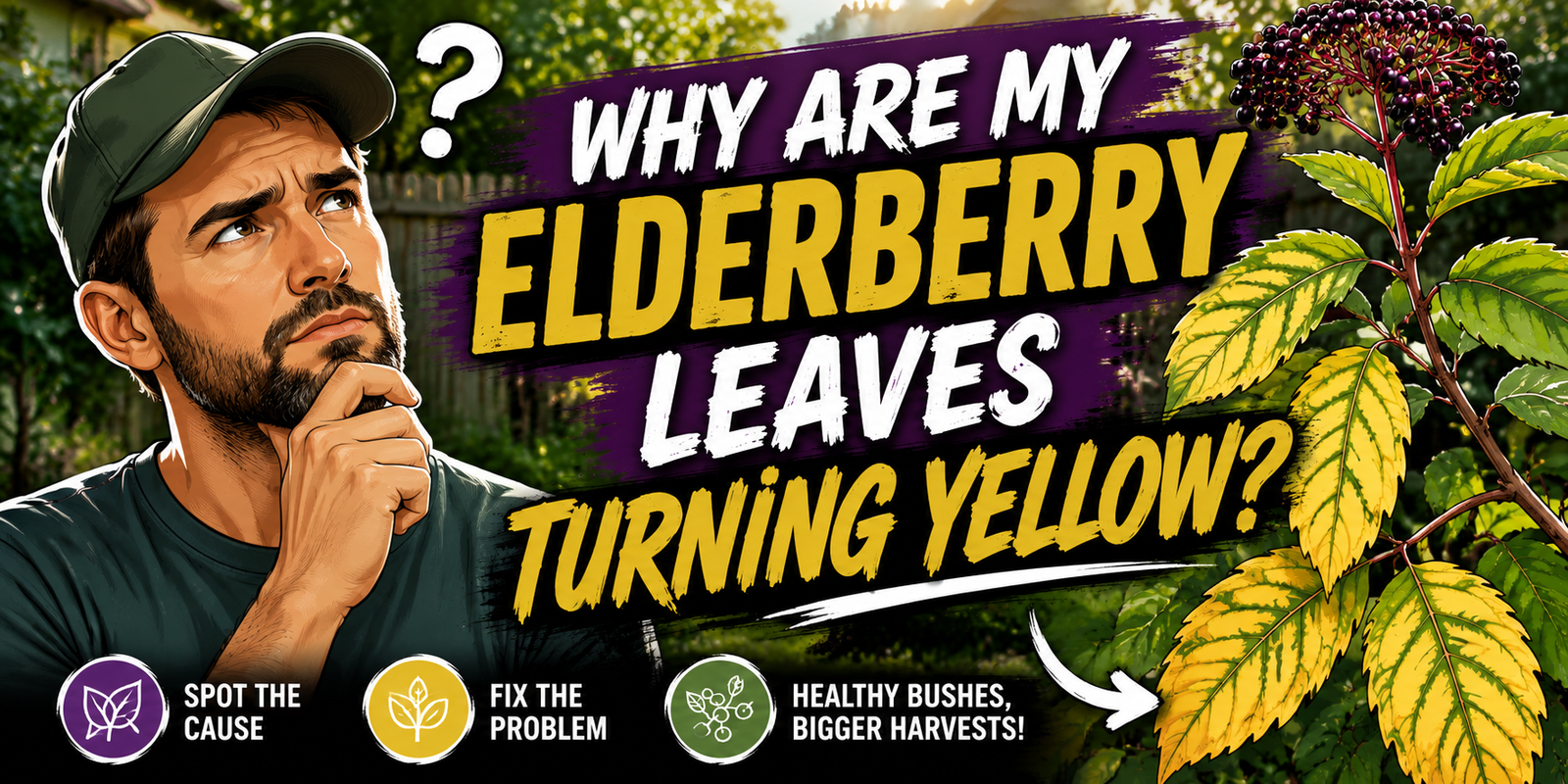
We already have a dedicated guide for that symptom, so rather than duplicate it here, use Why Are My Elderberry Leaves Turning Yellow? if discoloration is becoming as noticeable as the curling.
The more symptoms you can combine, the easier diagnosis becomes.
Curling Plus One Wilted Cane Is Different
Now imagine the leaves aren’t merely curled.
The entire cane they’re attached to is suddenly drooping.
And the rest of the bush looks normal.
That’s when I start thinking beyond leaf problems.
Follow the cane downward.
Look for stem damage.
Look for holes.
Boring insects can damage the inside of elderberry canes and cause growth above that damage to wilt.
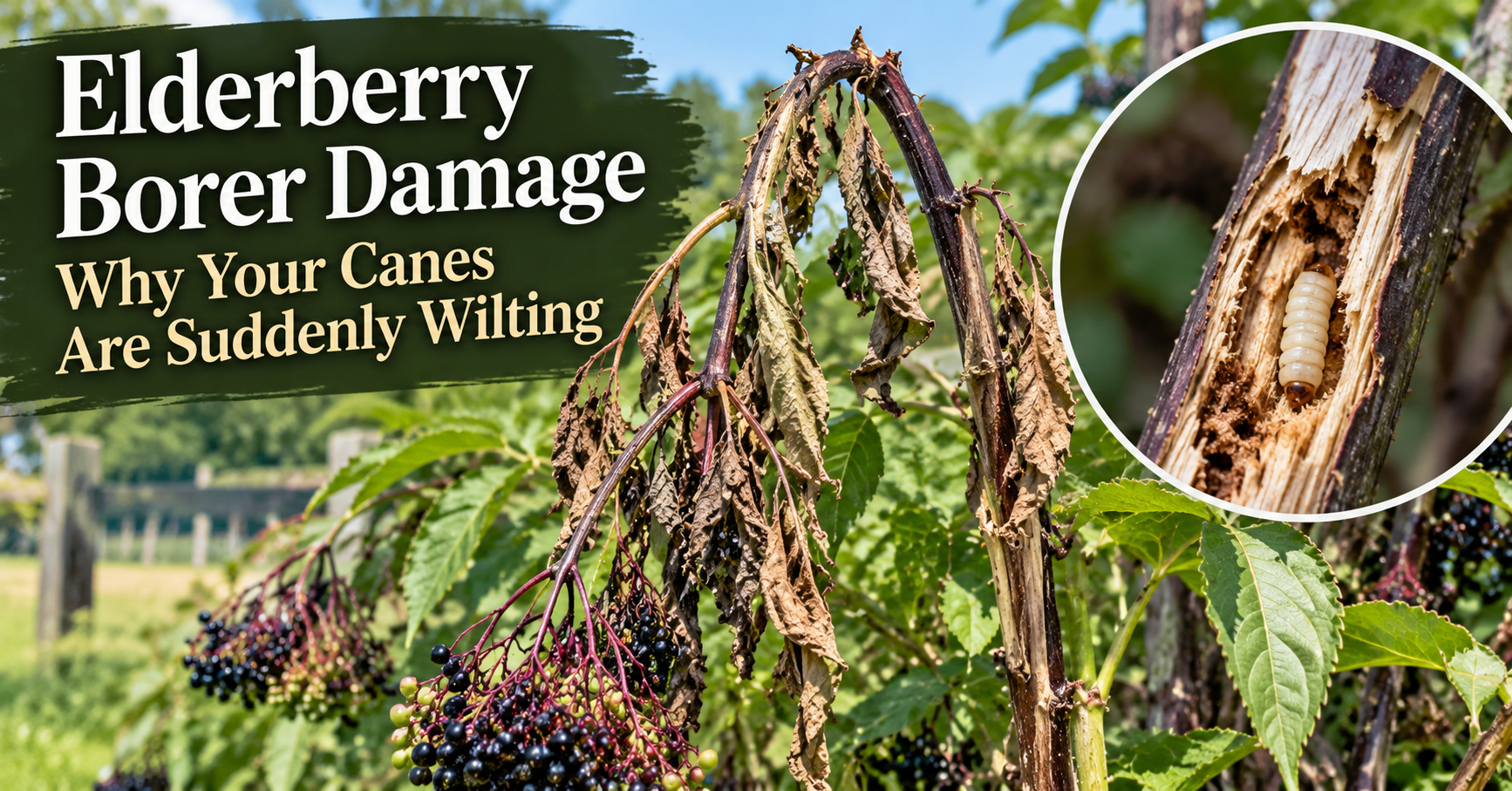
We just built a dedicated guide to elderberry borer damage because that’s a very different problem from generalized leaf curl.
One wilted cane deserves a stem inspection.
Curling Plus Whole-Plant Wilting Is Different Again
If practically the entire elderberry is drooping, I broaden the investigation even further.
Now root-zone moisture, transplant stress, heat, drainage, and other whole-plant problems become more important.

That’s where Why Is My Elderberry Bush Wilting? becomes the better troubleshooting guide.
I don’t want five Elderberry Pro articles all pretending to answer the same symptom.
Use the dominant symptom to choose the diagnostic path.
Curled leaves: stay here.
Yellow leaves: yellowing guide.
One suddenly wilted cane: inspect for borers.
Whole bush wilting: use the broader wilting guide.
That keeps troubleshooting much cleaner.
Cause 6. Spider Mites and Other Tiny Pests
Spider mites can also stress foliage, particularly during hot, dry conditions.
Their damage often comes with additional clues such as stippling or fine webbing.
They’re tiny, so don’t expect them to look like obvious beetles sitting on the leaf.
Inspect the undersides closely.
A magnifying glass can help.
One trick gardeners use is holding a sheet of white paper beneath affected foliage and tapping the leaf.
Tiny moving specks become much easier to notice against white paper than against green foliage.
Again, I’m looking for evidence before treating.
What About Elderberry Rust?
Elderberries can develop rust diseases, but curling alone isn’t enough for me to call something rust.
Rust generally gives you more to work with than leaf shape.
Look for unusual colored growth, pustules, spots, or other visible disease signs.
If you’re seeing distinctive orange growth along with distorted foliage, disease moves much higher on the list.
If the leaves are simply curling inward with no spots or obvious fungal structures, I keep investigating other causes.
Look Under the Leaf Before You Do Anything Else
If you remember one practical thing from this article, make it this.
Flip the leaf over.
Gardeners naturally look at the top surface.
Pests don’t necessarily cooperate by sitting there in plain sight.
Inspect:
the underside,
the petiole,
the newest shoots,
the growing tips,
and nearby leaves that haven’t curled yet.
Aphids may be clustered where you weren’t looking.
Mite damage may be most obvious on new growth.
Sticky residue may reveal a sap-feeding insect.
Fine webbing may point you somewhere else.
Ten seconds of inspection can save you from applying the completely wrong treatment.
My Step-by-Step Check for Curled Elderberry Leaves
If I walked outside tomorrow and found curled leaves on one of my elderberries, I wouldn’t start by treating anything.
I’d investigate in this order.
Step 1. Look at Which Leaves Are Curling
Is it mostly new growth?
Old leaves?
One cane?
The entire bush?
A few leaves?
The pattern immediately starts narrowing the possibilities.
Distorted new growth makes me especially interested in mites, aphids, herbicide injury, and other things affecting developing tissue.
Step 2. Turn the Leaves Over
Look carefully at the undersides.
I’m searching for:
aphids,
webbing,
tiny moving pests,
sticky residue,
unusual spots,
or anything else that shouldn’t be there.
Use a magnifying glass if necessary.
Some of the organisms capable of damaging elderberry leaves are extremely small.
Step 3. Look at the Growing Tips
Don’t stop at one curled leaf.
Look at the newest growth on several canes.
Are all the growing tips distorted?
Only one?
Is the new growth tightly puckered?
Are leaves narrow and twisted?
Are neighboring plants showing the same strange growth?
That last question becomes particularly useful when I’m considering herbicide drift.
Step 4. Check the Soil
Now I actually touch the soil.
Is it extremely dry?
Saturated?
Does water drain reasonably?
Has the weather been unusually hot and dry?
Did the area recently receive a huge amount of rain?
This helps me decide whether water stress belongs near the top or bottom of my list.
Step 5. Inspect the Canes
If curling is accompanied by substantial wilting or dieback, I look beyond the leaves.
Check the cane.
Look for:
holes,
tunneling,
damage,
cankers,
breakage,
or other abnormalities.
The leaves may be showing you a problem that actually started farther down the plant.
Step 6. Think About What Happened Recently
This is one of the most useful diagnostic questions.
Did you recently fertilize?
Spray weeds?
Apply weed-and-feed?
Transplant the elderberry?
Experience extreme heat?
Get several days of heavy rain?
Have drought conditions?
Notice a sudden increase in insects?
Plants don’t exist in isolation from everything happening around them.
The timeline can be incredibly revealing.
Will Curled Elderberry Leaves Straighten Back Out?
Sometimes damaged leaves remain damaged.
That’s why I don’t judge recovery solely by whether an already distorted leaf becomes perfect again.
If a young leaf developed while mites were feeding on it or while the plant was exposed to herbicide drift, its shape may remain abnormal.
I’m more interested in what happens next.
Does new growth emerge normally?
That’s a much better sign.
If the plant begins producing healthy, normally shaped leaves after the underlying stress is corrected, I know something has improved even if the older curled foliage still looks ugly.
Should You Remove Curled Leaves?
Not automatically.
A curled leaf isn’t necessarily dead.
If it’s still green and functioning, removing every imperfect leaf can take photosynthetic tissue away from a plant that’s already stressed.
I would be more interested in removing foliage when there’s a specific reason.
For example:
severe pest infestation,
obvious disease,
dead tissue,
or badly damaged growth that needs to be pruned for another reason.
I don’t prune simply because I don’t like how a leaf looks.
Diagnosis first.
Should You Cut Off an Entire Curled Cane?
Again, not based on leaf curl alone.
If the cane itself is healthy and only the foliage is distorted, cutting the entire cane may be unnecessary.
But if the cane is dying, badly damaged, infested with a borer, or affected by another serious stem problem, removal may make sense.
Look at the whole cane.
A leaf symptom and a cane problem aren’t automatically the same thing.
What If Only the Top Leaves Are Curling?
When distortion is concentrated in the newest growth, I become particularly interested in things affecting actively developing tissue.
That’s where I’d look closely for:
eriophyid mite damage,
aphids,
herbicide injury,
and other stresses occurring while the leaves were expanding.
Compare those new leaves with older foliage lower on the same cane.
If the older leaves look completely normal while every new leaf is twisted, something changed.
Now ask:
What changed recently?
That question can be more useful than staring at the leaf itself.
What If the Lower Leaves Are Curling?
Older lower foliage can point me in a different direction.
Now I pay closer attention to:
water stress,
root conditions,
nutrition,
natural aging,
and whether the lower leaves are also changing color.
Again, curling by itself doesn’t give me the entire answer.
Combine symptoms.
Curling plus yellowing tells me more than curling alone.
Curling plus spots tells me something else.
Curling plus sticky residue sends me toward insects.
The plant is giving you multiple pieces of information.
Use all of them.
What If the Leaves Are Curling Upward?
I wouldn’t diagnose an elderberry solely based on whether the leaf edges point upward or downward.
Online plant advice sometimes turns leaf direction into a magical diagnostic tool:
Up means this.
Down means that.
Real plants aren’t always that cooperative.
I care much more about the complete symptom pattern.
Is the soil dry?
Are insects present?
Is there stippling?
Is new growth distorted?
Did herbicide exposure occur?
Are leaves yellow?
Are they puckered between the veins?
Those clues are much stronger than curl direction by itself.
What If They’re Curling Inward?
Inward curling becomes particularly interesting because Missouri Extension specifically describes inward leaflet curl associated with eriophyid mite damage on elderberry.
That doesn’t mean inward curl automatically proves mites.
But it absolutely gives me a reason to inspect the newest foliage carefully.
Look for puckering and stunting as well.
If that pattern matches and other causes don’t fit, mites move much higher on my list.
What If the Leaves Are Curled and Sticky?
Now aphids jump toward the top.
Turn the leaves over.
Inspect tender stems.
Look around the growing tips.
Search for groups of tiny insects.
Also watch for ants.
Ant activity around sticky curled foliage can be another clue that honeydew-producing insects are present.
This is one of those situations where several clues can line up nicely.
What If They’re Curled With Fine Webbing?
Look closely for spider mites.
Fine webbing combined with stippled or stressed foliage during hot, dry weather deserves investigation.
A magnifying glass helps.
The white-paper tapping trick can help too.
Hold white paper beneath the affected foliage.
Tap the leaf.
Then look for tiny moving specks.
If you find them, you’ve learned much more than you would from spraying the plant based on leaf shape alone.
What If the Leaves Are Twisted Into Bizarre Shapes?
Think about herbicide exposure.
Especially if the newest growth looks dramatically deformed rather than simply rolled.
Then look around.
Are nearby broadleaf plants distorted too?
Did someone recently spray weeds?
Was the lawn treated?
Was it windy?
Could spray have drifted from another area?
Herbicide injury can create some genuinely strange plant growth.
The pattern across multiple plants can be one of your strongest clues.
Don’t Fertilize Curled Leaves Just Because They Look Unhealthy
This deserves repeating.
Ugly leaves don’t automatically mean hungry plant.
If mites are causing the problem, fertilizer doesn’t kill mites.
If aphids are feeding on the leaves, fertilizer doesn’t remove aphids.
If herbicide drift damaged the new growth, fertilizer doesn’t neutralize the herbicide.
If the root zone is waterlogged, adding fertilizer may simply give a stressed root system another problem to deal with.
Only fertilize because the plant actually needs nutrients.
Not because the leaves scared you.
Don’t Spray Everything Either
The same principle applies to pesticides.
A fungicide won’t fix herbicide drift.
An insecticide won’t fix drought.
More water won’t fix a borer.
Fertilizer won’t fix mites.
The fastest way to waste money in the garden is treating symptoms before understanding the cause.
Sometimes ten minutes of careful inspection is more useful than a shelf full of garden chemicals.
How Can You Prevent Elderberry Leaf Curl?
You can’t prevent every pest, weather event, or accidental exposure.
But you can reduce unnecessary stress.
Give elderberries adequate water without keeping roots constantly saturated.
Plant them where they’ll receive suitable sunlight.
Maintain reasonable fertility rather than overfeeding.
Inspect new growth occasionally.
Avoid careless herbicide use near the plants.
Keep an eye on recurring pest problems.
And maintain the bush so you can actually see what’s happening.
A huge tangled elderberry is much harder to inspect than a reasonably managed one.
Healthy Plants Make Troubleshooting Easier
This is another reason I keep coming back to good basic growing conditions.
When I already know:
the watering is appropriate,
the plant has adequate sunlight,
the soil isn’t flooded,
and the bush has been growing vigorously,
I can eliminate some possibilities faster.
Good care doesn’t guarantee you’ll never see curled leaves.
It gives you a healthier baseline.

If you’re still figuring out the overall growing side, my Ultimate Guide to Growing Elderberries Successfully brings the major growing requirements together without turning this troubleshooting article into another general growing guide.
When I’d Ask Extension for Help
If the distortion is severe, recurring, spreading rapidly, or simply doesn’t match anything I can confidently identify, I’d get another set of eyes on it.
Your local Cooperative Extension office can be extremely helpful with plant problems.
Take clear photographs.
Get pictures of:
the entire elderberry,
the affected cane,
healthy leaves,
damaged leaves,
the top and underside of the leaf,
and any insects or unusual stem damage you find.
Don’t send one blurry close-up of a curled leaf and expect someone to reconstruct the entire plant.
Context helps.
Sometimes a Physical Sample Is Even Better
Tiny mites, subtle disease symptoms, and unusual tissue damage aren’t always easy to diagnose from photographs.
Depending on your local Extension service, they may recommend submitting a physical plant sample or sending it to a diagnostic laboratory.
That’s especially worthwhile if the problem keeps returning or affects multiple elderberries.
Getting a real diagnosis once can save you from applying the wrong treatment every year.
My Quick Elderberry Leaf Curl Checklist
If I find curled elderberry leaves, here’s the order I’d actually use:
Look underneath the leaf.
Any aphids, webbing, or visible pests?
Examine the newest growth.
Puckered? Stunted? Twisted? Strap-like?
Compare old and new leaves.
Is the problem only affecting growth produced recently?
Check the soil.
Dry, moist, or saturated?
Look at nearby plants.
Are other broadleaf plants distorted too?
Think about recent spraying.
Any weed killer, lawn treatment, or nearby herbicide use?
Inspect the cane.
Any holes, dieback, or structural damage?
Combine the symptoms.
Yellow? Sticky? Spotted? Wilted? Webbed?
Then make a decision.
Not before.
Curled Leaves Are a Symptom, Not a Diagnosis
That’s really the biggest point.
“Leaf curl” describes what you’re seeing.
It doesn’t tell you why it’s happening.
Eriophyid mites can curl elderberry leaves.
Aphids can distort them.
Water stress can change leaf shape.
Herbicide drift can twist new growth dramatically.
Other pests, diseases, root problems, and environmental stresses can contribute too.
The answer comes from the other clues surrounding the curl.
So before you water again, fertilize again, spray again, or cut half the bush off, look closely.
Turn the leaves over.
Check the soil.
Inspect the stems.
Think about what changed.
Compare damaged growth with healthy growth.
Your elderberry is usually giving you more information than one curled leaf makes it seem.
You just have to look at the whole plant before deciding what it’s trying to tell you.
About the Author
Avery Collins writes about growing, troubleshooting, propagating, and harvesting elderberries for Elderberry Pro. Avery focuses on practical backyard-growing information that helps gardeners identify plant problems from the actual symptoms before applying unnecessary treatments.