
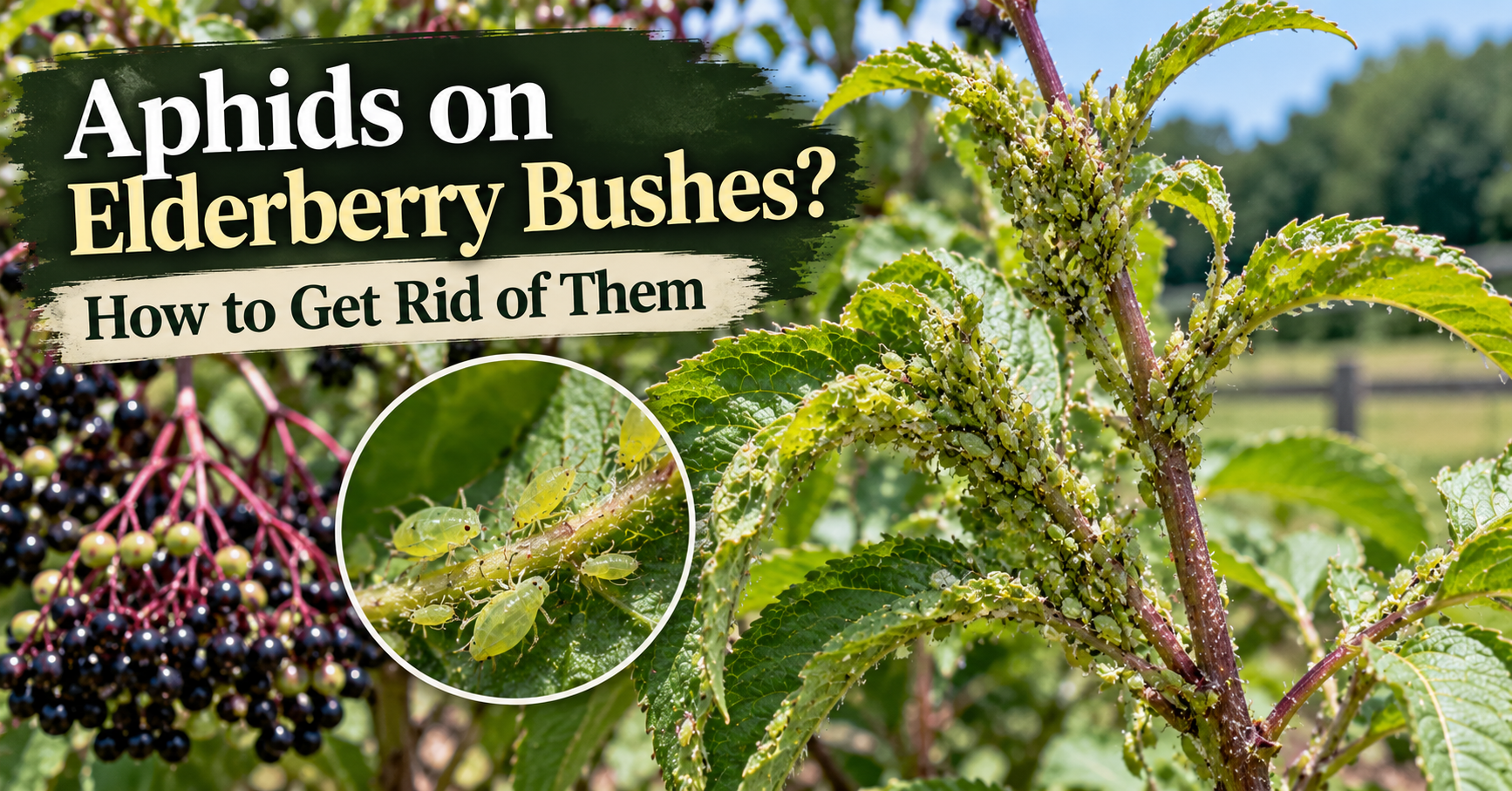
Finding a bunch of tiny bugs packed onto the newest growth of an elderberry bush can look pretty alarming.
Especially when the leaves around them are curling.
Then you notice something sticky.
Maybe ants are crawling up and down the cane too.
At that point, there’s a good chance you’re looking at aphids.
The good news is that finding a few aphids doesn’t mean your elderberry bush is doomed.
In fact, one of the biggest mistakes I think gardeners make with aphids is going straight from:
I found bugs.
to:
I need to spray the entire plant.
Sometimes you don’t.
Aphids have plenty of natural predators, established elderberries can tolerate some insect feeding, and a small infestation can often be handled with surprisingly simple methods.
So before you spray anything, here’s how I’d confirm that the insects are actually aphids, decide whether they’re causing enough damage to matter, and choose the least disruptive way to deal with them.
What Do Aphids on Elderberries Look Like?
Aphids are small, soft-bodied insects that feed by sucking plant sap.
They may appear in groups rather than as one insect wandering around by itself.
The first places I’d inspect are:
- Tender new shoots.
- The undersides of leaves.
- Growing tips.
- Leaf stems.
- Young foliage that’s beginning to curl.
Aphids can vary in color depending on species and life stage, so I wouldn’t diagnose them based solely on whether the bug is green, black, yellow, or another color.
Look at the insect’s body shape and behavior too.


Check the Newest Growth First
Tender growth is where aphids can become especially noticeable.
Young elderberry leaves and shoots are actively growing and easier for these sap-feeding insects to exploit than tougher older tissue.
So when I find a distorted growing tip, I don’t start by inspecting the oldest leaf near the bottom of the bush.
I look right where the new growth is developing.
Then I turn those leaves over.
Sometimes that’s all it takes.
A cluster of tiny insects hiding underneath suddenly explains why the new foliage looks so strange.



What Does Aphid Damage Look Like on Elderberry?
Aphid feeding can cause:
Curled leaves.
Puckered foliage.
Distorted new growth.
Yellowing in more heavily affected tissue.
Reduced vigor when infestations become substantial.
But here’s the important part:
Those symptoms aren’t exclusive to aphids.
Elderberry leaves can curl for several reasons.
That’s why I want to actually find aphids before blaming them.
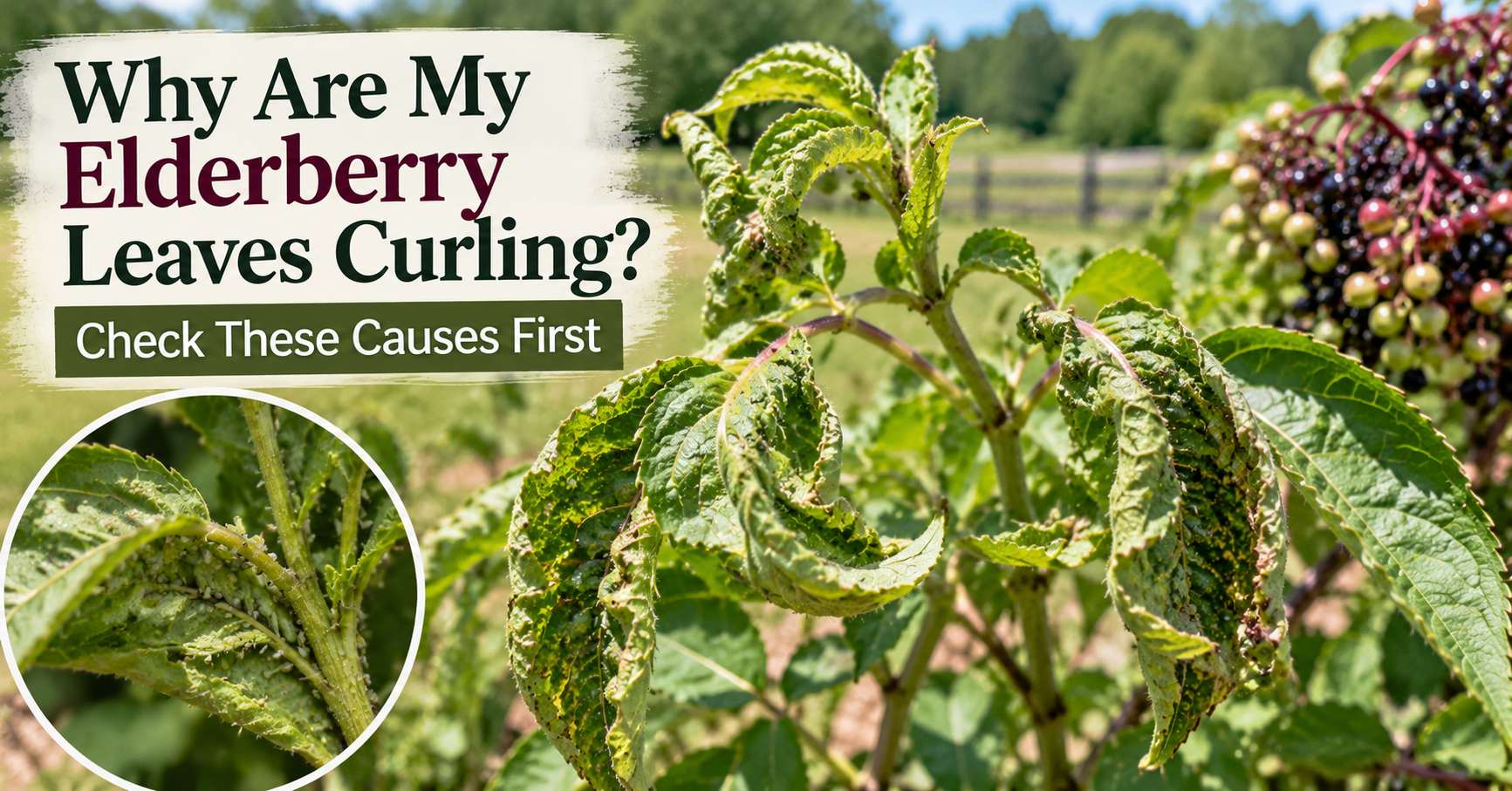
If your leaves are curling but you can’t find aphids anywhere, use my elderberry leaf curl troubleshooting guide instead of treating invisible aphids that may not exist.
That guide covers mites, water stress, herbicide drift, nutrition, and other causes separately.
Sticky Elderberry Leaves Are a Big Aphid Clue
This is one of my favorite clues.
Aphids produce a sugary waste material called honeydew.
It can coat leaves and other surfaces underneath the feeding insects.
That makes foliage feel sticky.
If I’m looking at:
curled new growth + visible tiny insects + sticky leaves
aphids become much more convincing.
And there’s another clue that frequently joins the party.
Ants.
Why Are Ants Crawling All Over My Elderberry?
If ants suddenly seem obsessed with an elderberry shoot, look for aphids.
Ants are attracted to the sugary honeydew aphids produce.
Some ants even protect aphid colonies from predators because that honeydew is a valuable food source.
So the ants themselves may not be what’s damaging the elderberry.
They can be a clue pointing you toward the actual sap-feeding insects.
Follow the ants.
Inspect the tender growth they’re visiting.
Turn the leaves over.
You may find the aphid colony they’ve been tending.
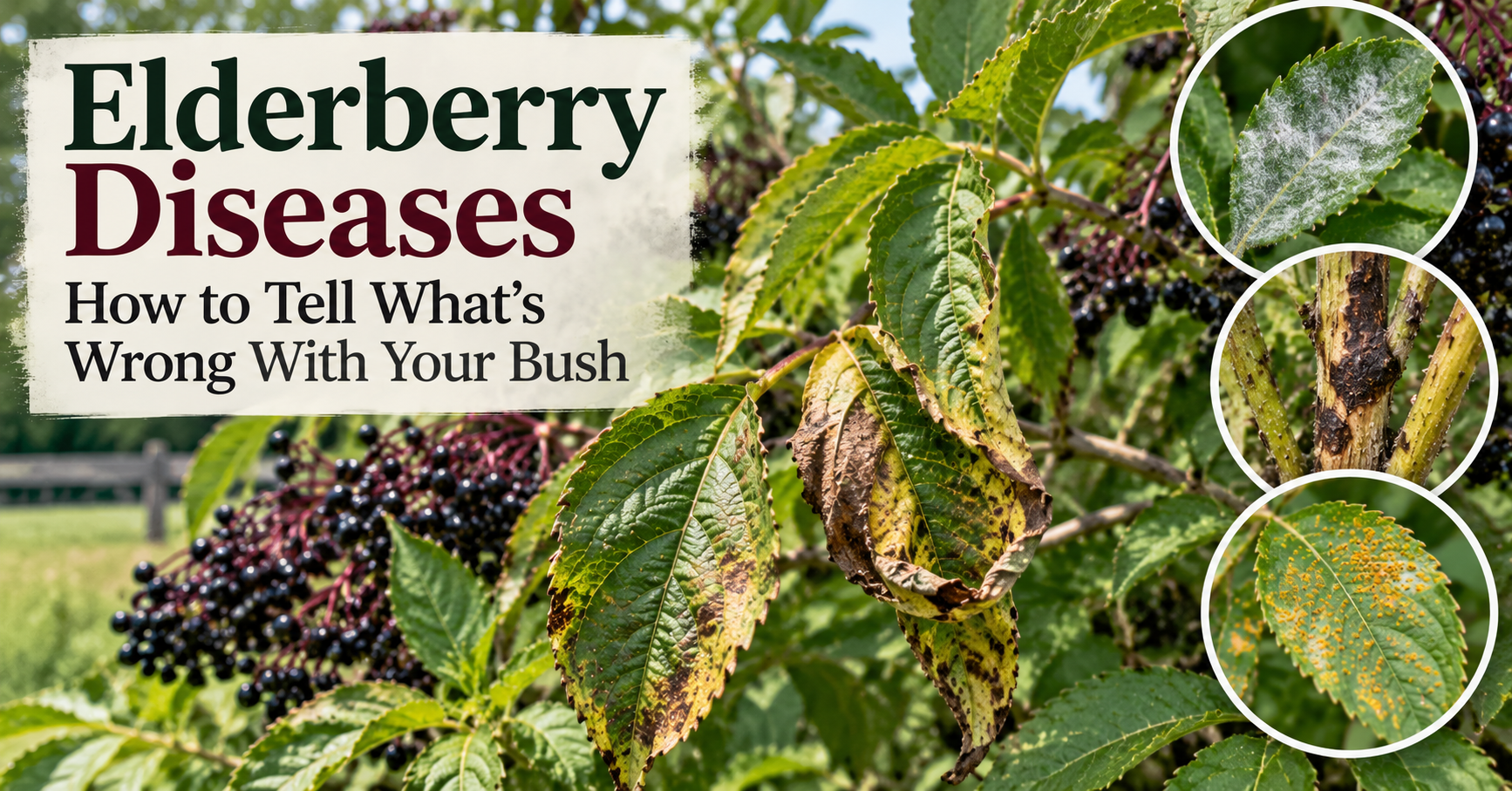
What Is the Black Stuff Growing on Sticky Leaves?
Heavy honeydew accumulation can encourage sooty mold.
This dark fungal growth develops on the sugary material coating plant surfaces.
It can make leaves look dirty or blackened.
That doesn’t necessarily mean the fungus itself originally attacked the elderberry tissue.
The aphids created the honeydew.
The honeydew created an environment where sooty mold could develop.
So if I see:
aphids,
sticky leaves,
and black surface growth,
I don’t treat those as three completely unrelated mysteries.
They’re probably connected.
Reduce the aphid problem and you reduce the source of the honeydew.


Are Aphids Killing My Elderberry Bush?
Usually, finding a small aphid colony isn’t enough for me to assume the entire bush is in danger.
A mature, vigorous elderberry can tolerate some insect feeding.
That’s especially true when natural predators are already beginning to appear.
What concerns me more is a heavy infestation concentrated on tender growth.
If growing tips are becoming badly distorted, leaves are heavily curled, honeydew is covering the plant, and aphids are multiplying faster than predators are controlling them, I become more interested in intervening.
A tiny colony and a severe infestation shouldn’t receive the exact same response.
Young Elderberry Plants Deserve More Attention
A large established elderberry has a lot of foliage and many canes.
A newly planted elderberry doesn’t.
That means the same number of aphids can represent a much larger proportion of the available new growth on a young plant.
If aphids are heavily covering the few growing tips a young elderberry has, I wouldn’t ignore them simply because aphids usually aren’t catastrophic.
Context matters.
The size and health of the plant matter.


Do Aphids Damage Elderberry Flowers?
Aphids can feed on tender plant tissue, and infestations around developing shoots and flower structures can become undesirable.
But this is also when I become particularly cautious about treatment.
Elderberry flowers attract pollinators.
If bees and other insects are actively visiting the blossoms, I don’t want my response to aphids creating unnecessary risk for beneficial insects.
That makes targeted, low-impact management particularly attractive during flowering.
Start With Water
For a manageable aphid infestation, one of the simplest things I’d try is a strong stream of water.
Not enough pressure to shred the elderberry leaves.
Just enough to knock aphids off the plant.
Pay particular attention to the undersides of leaves and infested growing tips.
Aphids aren’t especially good at climbing back onto the plant after being dislodged.
For a backyard elderberry with a localized infestation, this can make a surprisingly noticeable difference.


Repeat the Water Treatment if Necessary
One rinse may not remove every aphid.
That’s okay.
Check the plant again.
If aphids are rebuilding on the same shoots, repeat the process.
This is cheap.
It doesn’t leave pesticide residue.
And I’m not blasting every beneficial insect in the garden with a broad-spectrum chemical.
For a small planting, that’s a pretty appealing first step.
Don’t Blast Delicate Flowers Apart
There’s a little common sense required here.
If the aphids are concentrated around elderberry flowers, I don’t point a high-pressure hose directly into the flower clusters and destroy the blossoms trying to remove insects.
Adjust the pressure.
Target affected areas carefully.
Remember what you’re trying to protect.
A pest-control method that damages the plant worse than the pest isn’t much of a victory.
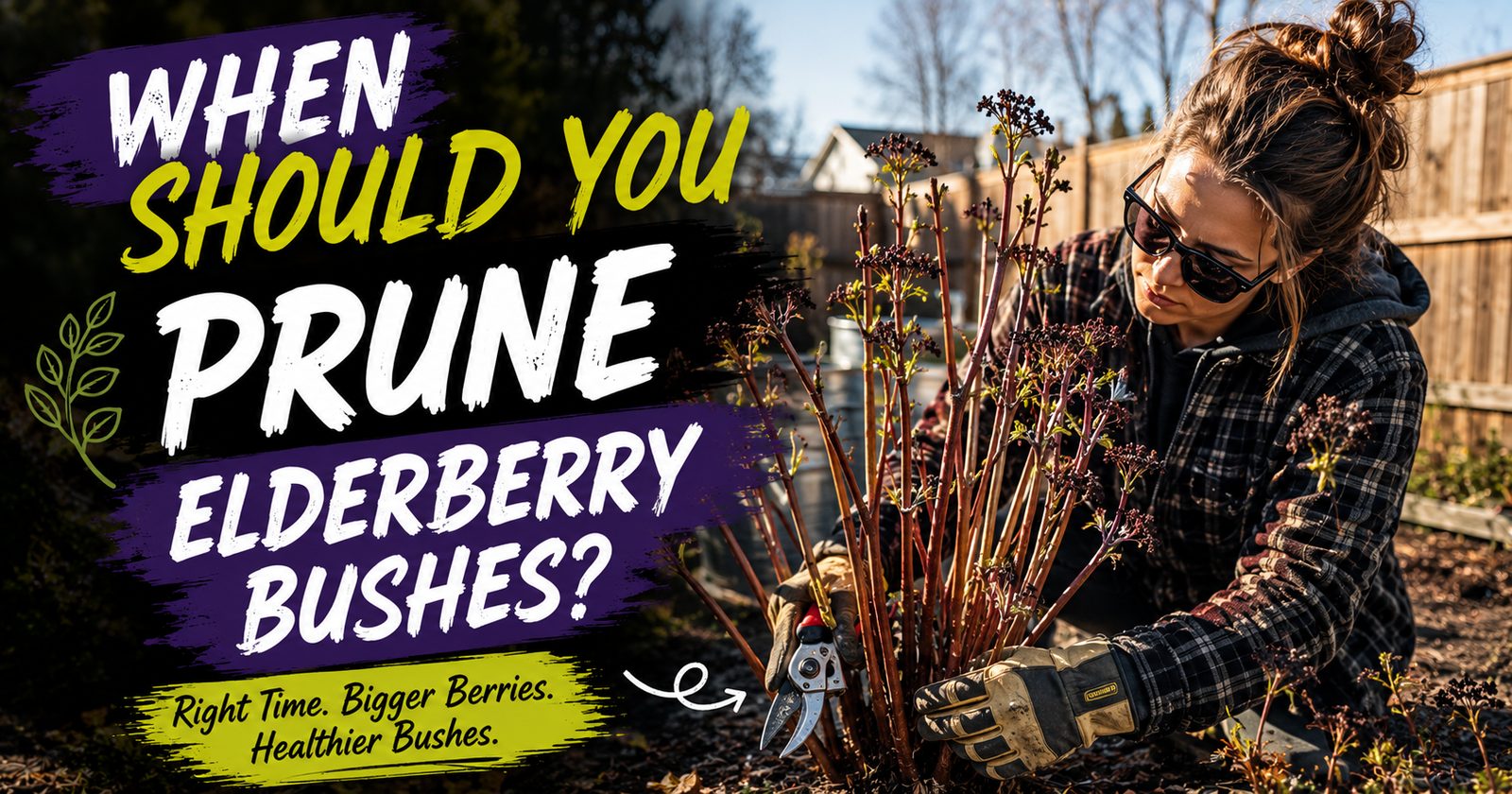
Prune Out a Heavily Infested Shoot When It Makes Sense
Sometimes one tender shoot is absolutely covered while the rest of the elderberry looks fine.
If that shoot isn’t particularly important and removing it won’t significantly harm the plant, pruning it out can eliminate a large portion of the aphid colony immediately.
Put the infested material somewhere the aphids aren’t simply crawling right back onto the bush.
Again, this works especially well in a small backyard planting where you can physically inspect individual shoots.
Lady Beetles Are Working for You
This is where patience can pay off.
Lady beetles and their larvae eat aphids.
The larvae are particularly important because people sometimes don’t recognize them and assume they’re another pest.
They look nothing like the familiar round red adult ladybug.
If I see lady beetle larvae actively moving through an aphid colony, I’m much less interested in immediately spraying everything.
Predators have already found dinner.
Give them a chance to work.
Lacewings Eat Aphids Too
Lacewing larvae are another valuable aphid predator.
They can consume large numbers of small soft-bodied insects.
Syrphid fly larvae can feed on aphids as well.
Parasitic wasps also attack aphids.
The garden has an entire group of organisms capable of helping with this problem.
That’s why I don’t view every insect on an elderberry as something that needs to die.
Some of them are doing pest control for free.
Learn What Aphid Predators Look Like
This is one of the easiest ways to avoid accidentally killing your helpers.
Before treating an aphid colony, look around it.
Do you see lady beetle larvae?
Lacewing larvae?
Tiny aphid “mummies” that look swollen and tan because a parasitoid developed inside them?
Those signs tell me biological control is already happening.
If the plant isn’t suffering serious damage, waiting and monitoring may be smarter than interfering.
What About Insecticidal Soap?
If aphids remain a significant problem despite simpler measures, insecticidal soap can be another option when the product is labeled appropriately for the plant and pest.
These products work through direct contact.
That means coverage matters.
You don’t spray the soil and expect aphids hiding underneath leaves to disappear.
You need to reach the insects.
But there’s something else that matters just as much:
Read the label.
Don’t assume every product called “soap” is appropriate for edible plants.
Dish Soap Isn’t Automatically Insecticidal Soap
This is a distinction I wish more gardening advice made.
Commercial insecticidal soaps are formulated for use on plants according to their labels.
Dishwashing detergent was formulated to clean dishes.
Random homemade concentrations can damage plant foliage.
So when someone says:
Just dump some dish soap in a spray bottle.
I don’t automatically treat that as equivalent to using a labeled horticultural product.
I’d rather use something designed and labeled for the job.
Test a Small Area First
Even products intended for plants can cause phytotoxicity under certain conditions.
Hot weather can increase the risk.
Plant stress can matter.
Concentration matters.
That’s why label instructions are so important.
If appropriate, test a small section before covering the entire elderberry.
Then watch the foliage.
The goal is controlling aphids without replacing insect damage with spray damage.
Avoid Spraying in the Heat of the Day
I don’t want to apply soap or oil products to stressed foliage during extreme heat unless the label specifically supports those conditions.
Early morning or another appropriate cooler period is often easier on plants.
Again, the product label wins.
It contains the actual instructions for that formulation.
Internet recipes don’t.
Be Extremely Careful Around Elderberry Flowers
This deserves its own section.
Elderberry flowers attract pollinators.
If the bush is actively blooming, I think about those insects before applying anything.
Even a product considered relatively low-impact isn’t something I casually spray directly onto bees or open flowers without checking its label.
If the aphid infestation is small, this is another reason I prefer:
water,
physical removal,
pruning a heavily infested shoot,
and allowing predators to work.
Target the problem instead of treating the entire ecosystem like an enemy.
What About Neem Oil for Aphids?
Neem products frequently come up whenever aphids are discussed.
Some neem-based products are labeled for controlling aphids and other soft-bodied pests, but I wouldn’t automatically spray neem simply because it’s commonly described online as “natural.”
Natural doesn’t mean harmless to everything except the pest.
The exact product matters.
The concentration matters.
Timing matters.
And whether it’s labeled for use on edible plants matters.
If I use any neem-based pesticide on elderberry, I follow that particular product’s label.
I also pay close attention to flowering because I don’t want to unnecessarily expose pollinators visiting elderberry blossoms.
Horticultural Oils Are Another Tool, Not an Automatic First Step
Horticultural oils can also help manage certain soft-bodied pests when they’re used correctly.
Like insecticidal soap, they generally depend heavily on contacting the pest.
They aren’t magic protective shields that make an elderberry permanently aphid-proof.
Temperature and plant condition can also affect how safely some oil products can be applied.
That’s another reason I start with the least complicated options.
If a hose and natural predators are keeping aphids under control, I don’t need to make the treatment more complicated just because additional products exist.
Be Cautious With Systemic Insecticides
Systemic insecticides deserve extra thought around flowering and fruit-producing plants.
These products can move through plant tissue rather than simply remaining where they’re sprayed.
For an ornamental shrub that might already require careful consideration.
For an elderberry I’m growing specifically for flowers and fruit, I’m even more cautious.
I wouldn’t use a systemic product unless it is specifically labeled for the plant, pest, and intended edible use.
And I wouldn’t ignore harvest intervals or pollinator warnings.
The pesticide label isn’t optional reading.
It’s the legal instruction for using that particular product.
Don’t Treat Aphids With Whatever Insecticide Happens to Be in the Garage
This is how unnecessary problems start.
You find aphids.
There’s an old bottle of insecticide on a shelf.
It kills insects.
Problem solved?
Not necessarily.
Maybe it isn’t labeled for elderberry.
Maybe it isn’t appropriate for an edible crop.
Maybe it has restrictions around flowering.
Maybe there’s a required period between application and harvest.
Maybe it kills beneficial insects that were already controlling the aphids.
Identify the pest first.
Then decide whether treatment is even necessary.
Then choose an appropriate labeled treatment if you actually need one.
Should You Get Rid of the Ants Too?
If ants are actively tending aphids and protecting them from predators, managing the ants may help natural aphid predators do their job.
But again, I want to understand what I’m seeing.
A few ants walking across an elderberry don’t automatically mean they’re running an aphid ranch.
Look for the connection.
Are they repeatedly visiting aphid-covered shoots?
Are they feeding on honeydew?
Are they aggressively moving around the colony?
If so, ant activity may be helping the aphid population persist.
Don’t Pour Random Ant Chemicals Around an Edible Plant
If ant management becomes necessary, I still think about the fact that I’m growing food.
I wouldn’t dump an unlabeled chemical around the elderberry root zone simply because ants are annoying me.
Use an appropriate product and placement strategy for the specific ant problem.
Sometimes addressing the aphids reduces the honeydew food source and makes the elderberry less interesting to the ants anyway.
Will Aphids Ruin Elderberries?
A few aphids don’t automatically ruin your berry crop.
Heavy infestations are more concerning because they can distort tender growth and stress the plant.
The timing matters too.
An established elderberry with lots of healthy foliage can tolerate more feeding than a tiny newly planted bush whose few growing tips are covered with aphids.
That’s why I don’t use an arbitrary rule like:
One aphid means spray.
Look at the plant.
Look at the infestation.
Look at the damage.
Then decide.
Can Aphids Get on the Berries?
Aphids are generally more interested in tender plant growth where they’re able to feed on sap.
You may still find insects wandering elsewhere on the plant.
If I’m harvesting elderberries, I inspect the fruit regardless.
Leaves, insects, damaged berries, stems, and other debris need to be sorted out before the berries are used.
And the fruit should be cleaned appropriately before preparation.
A few aphids appearing on the plant don’t make the entire berry harvest unusable.
Will Aphids Come Back Next Year?
They can.
Aphid populations are influenced by their life cycles, weather, host plants, predators, and surrounding vegetation.
That’s why I don’t think of aphid management as creating a permanently aphid-free elderberry.
I’m managing the population when it becomes damaging.
Some years may be worse than others.
And sometimes a noticeable early infestation collapses once predators catch up.
That natural rise and fall is another reason I don’t immediately spray every colony I see.
Too Much Nitrogen Can Encourage Tender Growth
This is another reason I avoid overfertilizing elderberries.
Excessive nitrogen can produce lots of lush, tender growth.
And tender new growth is exactly where aphids often concentrate.
That doesn’t mean fertilizer automatically causes aphids.
But I don’t want to create excessive soft growth by continually feeding a plant that doesn’t need it.
Use fertilizer because the elderberry needs nutrients, not because more fertilizer seems like it should always create a healthier plant.

If you’re unsure what your elderberry actually needs, use Best Fertilizer for Elderberry Bushes That Actually Worksrather than repeatedly adding nitrogen without a reason.
Keep Weeds and Unnecessary Growth Manageable
A completely sterile garden isn’t my goal.
But I do want to be able to inspect my elderberries.
If the base of the plant is buried inside weeds and tangled growth, pest monitoring becomes harder.
Reasonable weed control also reduces competition around young plants.
That doesn’t mean removing every flowering plant from the area.
Our companion-planting approach is about creating useful diversity without turning the elderberry into an inaccessible jungle.
Companion Plants Can Support Beneficial Insects, but They Aren’t Aphid Repellent Magic
Flowering plants around the elderberry can support a more diverse insect community.
That’s one reason I like having different flowers blooming throughout the season.
Predatory and parasitoid insects may use those resources.
But I wouldn’t tell you:
Plant this one flower and you’ll never see another aphid.
Gardens don’t work that neatly.
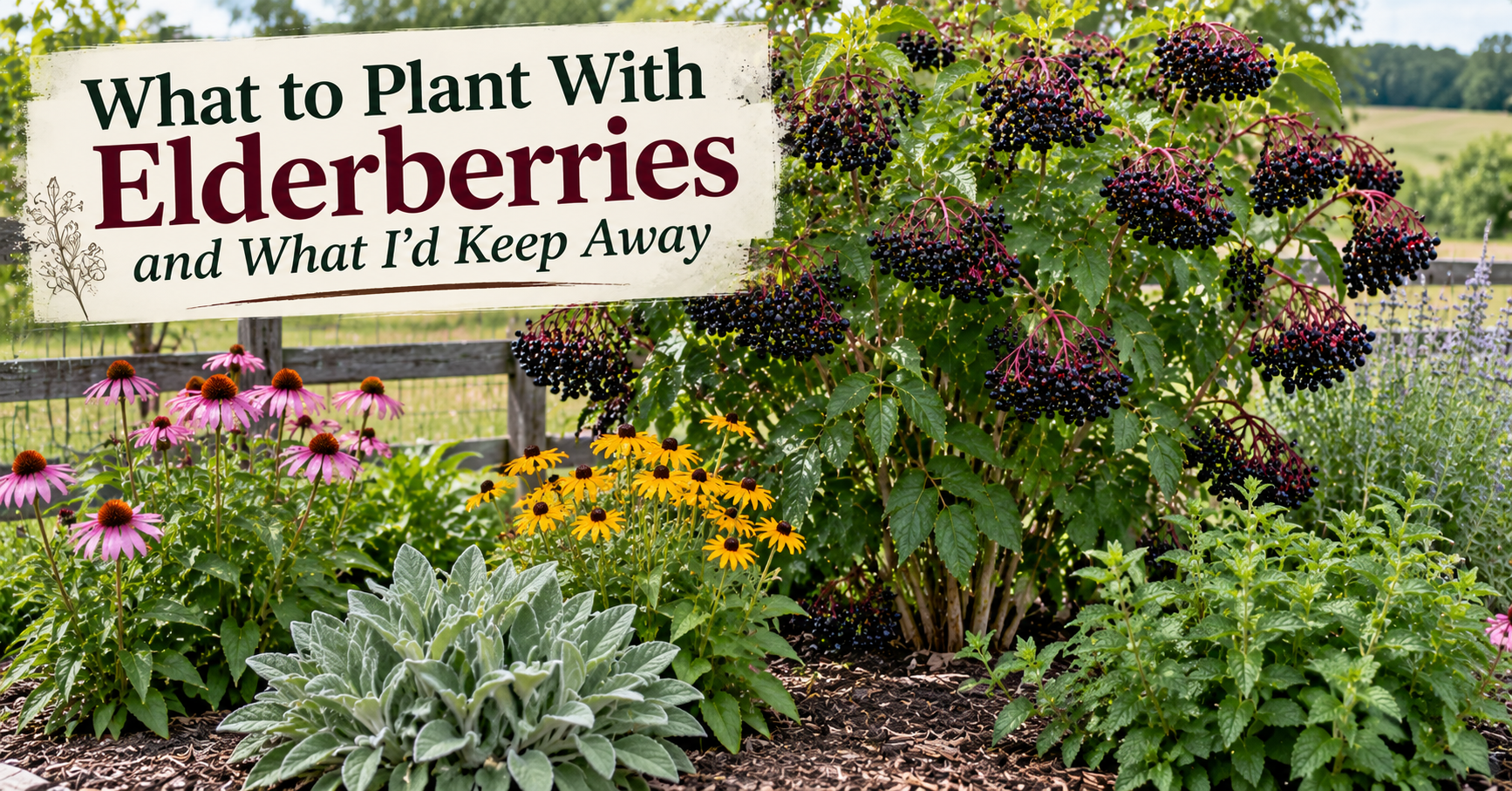
If you’re planning the area around your elderberries, What to Plant With Elderberries and What I’d Keep Awayexplains why I prefer compatible plants and useful habitat over unsupported companion-plant claims.
Don’t Kill the Beneficial Insects While Trying to Kill Aphids
This may be the biggest reason I avoid overreacting.
Imagine an elderberry has aphids.
Lady beetle larvae arrive.
Lacewing larvae arrive.
Parasitoids begin attacking aphids.
Then I spray a broad-spectrum insecticide across the entire plant.
I may kill plenty of aphids.
I may also eliminate insects that would have continued suppressing them.
Then another generation of aphids arrives without the same predator pressure.
That’s not necessarily an improvement.
The goal is managing the pest.
Not maximizing the number of dead insects in the garden.
When I Would Leave the Aphids Alone
I’d strongly consider monitoring rather than treating when:
- There are only a few aphids.
- The elderberry is healthy and vigorous.
- New growth isn’t becoming badly distorted.
- Natural predators are already present.
- The population isn’t obviously increasing.
- Flowers are open and pollinators are active.
Sometimes doing nothing immediately is a legitimate management decision.
Check again in a few days.
You may discover the beneficial insects handled the problem for you.
When I Would Actually Intervene
I’m much more likely to act when:
- Aphids heavily cover growing tips.
- New foliage is becoming significantly distorted.
- A young elderberry is being overwhelmed.
- Honeydew is becoming excessive.
- Sooty mold is developing heavily.
- The population continues increasing despite predators.
Even then, I start with the least disruptive effective option.
Water.
Physical removal.
Pruning one heavily infested shoot.
Then, if necessary, an appropriate labeled product.
My Aphid Control Order
If I walked outside and found aphids on an elderberry tomorrow, this is the order I’d actually use.
Confirm They’re Aphids
Look closely rather than assuming every tiny insect is the problem.
Check How Much Damage They’re Causing
A few insects aren’t the same as an infestation covering every growing tip.
Look for Predators
Lady beetles, lacewing larvae, syrphid larvae, and parasitoid activity may already be helping.
Knock Aphids Off With Water
Simple and targeted.
Recheck the Plant
Don’t assume one treatment solved everything.
Prune a Severely Infested Shoot if Appropriate
Especially when the infestation is extremely localized.
Consider Insecticidal Soap or Another Labeled Low-impact Option if Necessary
Follow the label and think about pollinators.
Escalate Only When the Problem Justifies It
Not because seeing bugs makes me uncomfortable.
That’s my entire approach.
What If Aphids Aren’t the Problem?
This is worth asking before you spend money treating them.
Maybe you have curled leaves but no aphids.
Maybe there’s no honeydew.
No ants tending colonies.
No visible insects.
The new foliage is simply distorted.
Now I’d stop treating for aphids.
Eriophyid mites can cause distinctive puckering and inward curling on elderberry.
Herbicide drift can twist new growth dramatically.
Water stress can change foliage too.
That’s why actual pest identification matters.
Don’t keep spraying for something you can’t find.
Aphids Are Usually Manageable When You Catch Them Early
Aphids look intimidating because they gather in groups.
One insect isn’t particularly dramatic.
Two hundred packed onto a tender shoot certainly are.
But that doesn’t mean the elderberry is finished.
Inspect the plant.
Decide how widespread the infestation actually is.
Look for natural predators.
Start with simple physical controls.
Protect pollinators.
Use labeled products only when the situation warrants them.
And keep watching the new growth.
If healthy new leaves begin developing normally and aphid numbers decline, you’re moving in the right direction.
Don’t Let Ten Tiny Bugs Turn Into Ten Unnecessary Treatments
That’s probably the biggest thing I’d want someone to take from this article.
Finding aphids doesn’t mean you’ve failed at growing elderberries.
They’re common garden insects.
Sometimes predators control them.
Sometimes a hose controls them.
Sometimes one badly infested shoot needs to come off.
And sometimes a larger infestation genuinely needs more active treatment.
The trick is knowing which situation you’re dealing with.
So before spraying anything, turn over the leaves.
Look at the growing tips.
Check for stickiness.
Watch the ants.
Look for predators.
Then make the smallest intervention that actually solves the problem.
That’s much better than turning one aphid colony into a chemical war across the entire elderberry bush.
About the Author
Avery Collins writes about growing, troubleshooting, propagating, and harvesting elderberries for Elderberry Pro. Avery focuses on practical backyard-growing information that helps gardeners identify what is actually happening on their plants before reaching for unnecessary treatments.