
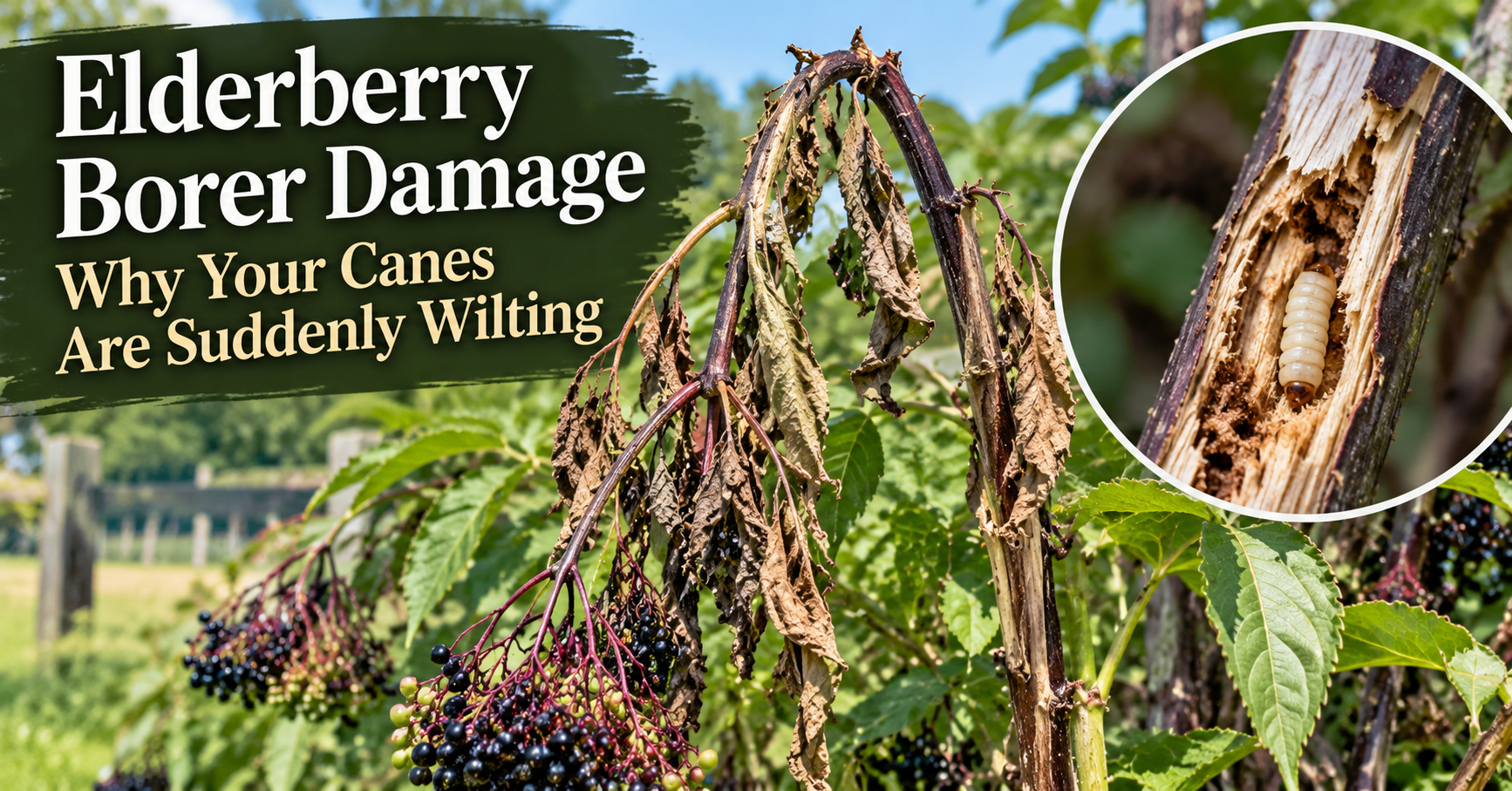
One elderberry cane suddenly wilting while the rest of the bush looks perfectly healthy gets my attention fast.
Especially when the soil isn’t dry.
The other canes aren’t drooping.
And watering doesn’t seem to change anything.
That’s when I stop assuming the entire elderberry bush has a water problem and start looking closely at the individual cane.
Sometimes the problem is inside it.
Elderberries can be attacked by boring insects whose larvae tunnel into shoots, canes, stems, or other plant tissue. That internal damage can interrupt the movement of water through the affected growth and leave you with one mysteriously wilted cane surrounded by an otherwise healthy-looking plant.
If that’s happening to your elderberry, don’t start pouring fertilizer or extra water around it yet.
Inspect the wilted cane for holes and tunneling first.
What Is an Elderberry Borer?
This is where the terminology gets confusing because more than one boring insect can damage elderberries.
One is the elderberry borer, a longhorn beetle associated with elder plants.
Another is the elder shoot borer, whose larvae can tunnel into elderberry shoots and stems.
Both can result in damage that gardeners loosely describe as “elderberry borer damage,” but they aren’t the same insect.
That’s important because I don’t want to look at one damaged stem and confidently tell you which insect caused it without actually seeing the insect or enough identifying evidence.
For a home grower, the first practical question is simpler:
Is something boring inside this cane?


What Does Elderberry Borer Damage Look Like?
One of the biggest clues is localized damage.
Instead of the entire bush wilting together, you may notice:
- One shoot suddenly drooping.
- A single cane wilting while neighboring canes remain healthy.
- A flower cluster or upper section of a stem flagging.
- Holes in the cane.
- Tunneling inside the stem.
- A weakened cane that breaks unusually easily.
- Dieback above the damaged area.
The exact symptoms depend on where the insect is feeding and how much internal tissue has been damaged.
That’s why I don’t diagnose a borer based on “my elderberry looks sad.”
I want evidence on the cane.



Start With the Wilted Cane
If only one part of the elderberry is collapsing, follow that growth downward.
Don’t just stare at the leaves.
Look at the cane supporting them.
Slowly inspect the stem from the wilted growth toward the base.
I’m looking for anything unusual.
A hole.
A damaged section.
Discoloration.
A weak point.
Splitting.
Material around an opening.
Or an area where the stem suddenly looks different.
Sometimes the problem is much easier to understand once you stop focusing on the leaves.
The leaves may simply be showing you what happened farther down the stem.
Look for an Entry Hole
A hole in an elderberry cane is one of the strongest reasons to investigate boring insects.
That doesn’t mean every mark on a stem proves you have elderberry borer.
Plants get damaged in plenty of ways.
But if I have:
a suddenly wilted cane + a suspicious hole in that same cane
I’m paying attention.
Inspect around the hole too.
Look for damaged plant tissue or other evidence that something has been working inside the stem.
If you’re comfortable sacrificing an already failing section, cutting into the affected cane can sometimes reveal what’s happening internally.


Cut Open a Badly Wilted Cane and Look Inside
If a cane is clearly dying and I’m going to remove it anyway, I’d inspect the interior.
A healthy elderberry stem has a distinctive pithy center.
A borer-damaged stem may reveal tunneling or other internal disruption.
You may even find a larva inside.
This can be much more informative than trying to identify the problem entirely from the outside.
Just remember that once you’ve cut the cane open, you’ve committed to removing that section.
I wouldn’t slice into healthy productive canes randomly because I read that borers exist.
Investigate the growth that’s actually showing symptoms.
Why Does a Borer Make an Elderberry Cane Wilt?
Think about what that cane has to accomplish.
Water absorbed by the roots needs to move upward.
The upper growth depends on functioning plant tissue below it.
Now put a tunneling insect inside that stem.
As the larva feeds and damages internal tissue, the cane may become less capable of supplying everything growing above the damaged area.
That’s when you can see dramatic symptoms.
The soil may contain plenty of moisture.
The root system may be functioning.
Most of the bush may look great.
Yet one cane acts like it hasn’t seen water in a week.
That’s because the problem isn’t necessarily getting water into the plant.
The problem may be moving it through the damaged cane.



Borer Damage Can Look Like a Watering Problem
This is why diagnosis matters.
Imagine seeing a wilted cane on a hot afternoon.
The obvious reaction is:
It needs water.
So you water it.
Still wilted.
You water again.
Still wilted.
Now the soil is soaked and the cane hasn’t improved.
If a borer has damaged the stem internally, extra water isn’t repairing that tunnel.
And now you may create an entirely separate root problem by keeping the soil excessively wet.
Whenever wilting is limited to one cane or one section, I look beyond watering.

If the entire bush is drooping or you can’t find evidence of stem damage, my broader guide on why an elderberry bush is wilting covers drought, excessive water, transplant shock, root problems, heat, and other causes.
That’s a different diagnostic path.
Elderberry Borer and Elder Shoot Borer Aren’t the Same Thing
This distinction is worth making because online discussions often use “borer” as though there’s only one insect involved.
The elderberry borer is associated with a striking longhorn beetle.
The adult beetle itself can be noticeable, but much of the serious damage comes from the larval stage boring into elder plant tissue.
The elder shoot borer is different.
Its larvae can bore into new elderberry shoots and canes, causing affected growth to wilt.
For the gardener standing beside a damaged plant, both problems can lead to the same practical observation:
Something has tunneled into growth that should be healthy.
Identification becomes more precise when you can see the insect, larva, characteristic damage, or other distinguishing features.



What Does an Adult Elderberry Borer Look Like?
The adult elderberry borer is not some tiny boring beetle you’d need a microscope to notice.
It’s a longhorn beetle with a distinctive appearance.
Adults are associated with elder plants and may feed on elderberry foliage and flowers.
If you find an unfamiliar longhorn beetle repeatedly hanging around elderberries that also have boring damage, that’s worth investigating.
But don’t kill every beetle you see near an elderberry bush.
There are many beetle species.
Correct identification matters.
The presence of one random insect on a leaf isn’t enough for me to diagnose the entire problem.
What Does the Larva Look Like?
The larval stage is the part doing the internal boring.
If you cut into a clearly damaged cane and find a pale, grub-like larva inside the tunneling area, that’s much stronger evidence than seeing an unrelated insect walking across a leaf.
Again, species-level identification may require more than simply seeing “a grub.”
But now you have something concrete.
Take clear photographs.
Photograph the larva.
Photograph the tunnel.
Photograph the entry area.
Photograph the whole affected cane.
Those pictures can be incredibly useful if you need help from your local Extension office identifying exactly what you’re dealing with.

When Do Elderberry Borers Cause Problems?
Borer activity follows the insect’s life cycle, so symptoms are often most noticeable during the growing season.
That’s also when elderberries are actively producing shoots, leaves, flowers, and fruit.
A wilted shoot is particularly obvious against an otherwise vigorous green plant.
This is one reason I inspect my elderberries while I’m already doing normal garden work.
You don’t need to conduct a formal pest survey every morning.
Just pay attention.
A cane that looked healthy and upright and then suddenly starts flagging deserves a closer look.
What Should You Do With a Borer-Damaged Cane?
If I’ve confirmed that a cane or shoot is infested and dying, I don’t see much value in leaving the damaged growth attached indefinitely.
Extension recommendations for elder shoot borer include pruning out infested shoots and canes.
The goal is to remove the affected plant material rather than allowing the larva to continue developing inside it.
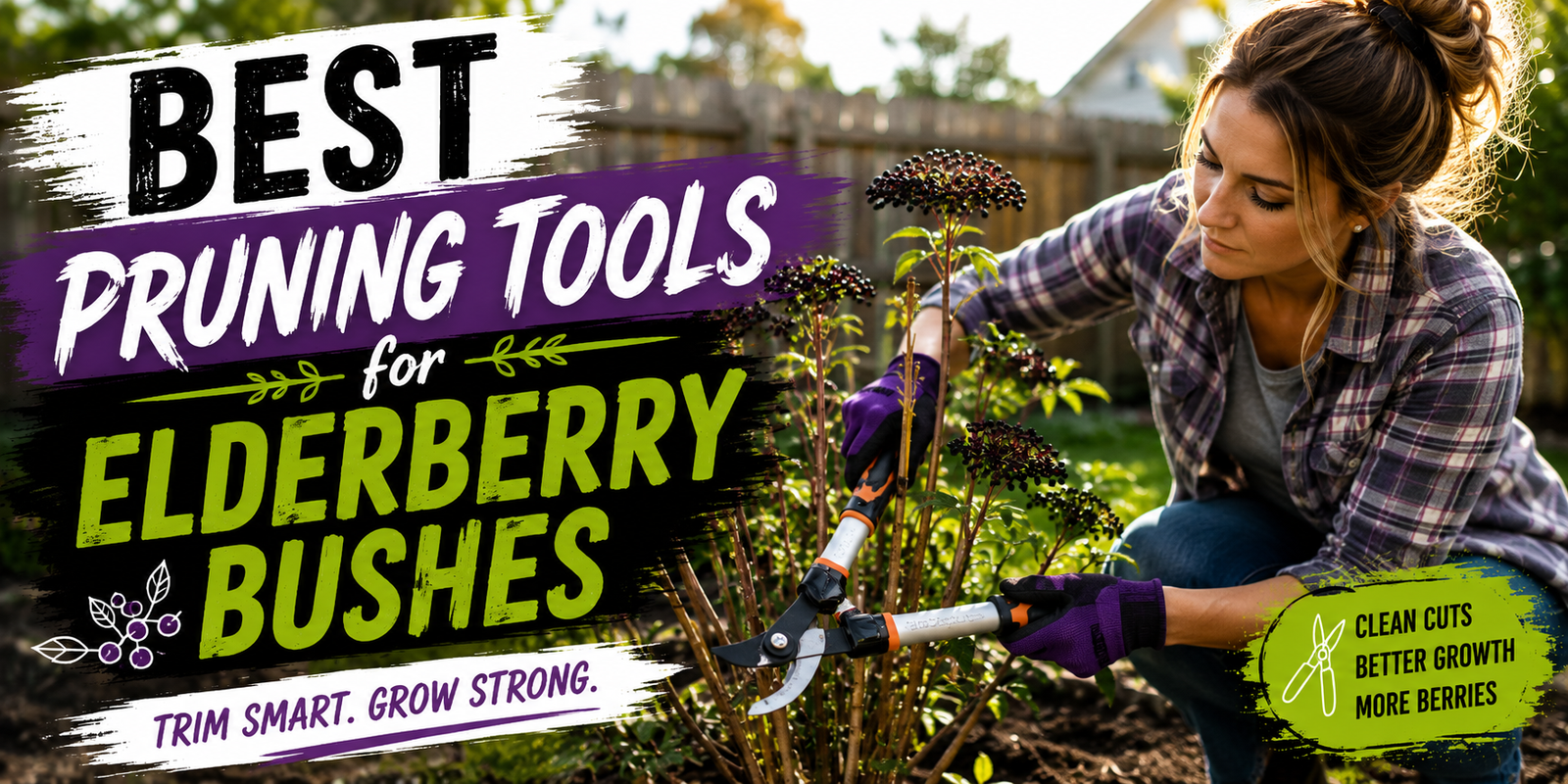
I would use clean, sharp pruning tools and cut back into healthy growth below the damaged portion.
How far down that needs to be depends on where the tunneling extends.
That’s another reason cutting open the removed cane can be useful.
You can see whether the internal damage continues farther than you initially thought.
Don’t Leave the Infested Cane Beside the Bush
Once I’ve removed plant material containing a borer or obvious tunneling, I don’t toss it on the ground underneath the elderberry.
And I wouldn’t casually put confirmed infested cane material into a compost pile where the insect may potentially survive.
The point of removing the infestation is to actually remove it from the planting.
Bagging, destroying, or otherwise disposing of confirmed infested material appropriately makes more sense than pruning it out and leaving the pest ten feet away.
Can an Elderberry Bush Survive Borer Damage?
Yes, losing one cane does not automatically mean you’ve lost the entire elderberry bush.
That’s one advantage of elderberry’s growth habit.
These are multi-stemmed shrubs.
A healthy established plant may have numerous canes emerging from the crown.
If one cane becomes badly damaged and needs to be removed, healthy remaining canes can continue growing.
The plant can also produce new growth.
That doesn’t mean I ignore repeated borer damage.
But I also don’t assume one damaged cane means I need to dig up and destroy an otherwise healthy mature elderberry.
When I’d Be More Concerned
One isolated damaged shoot is very different from finding widespread boring damage throughout the planting.
I’d become considerably more concerned if:
- Multiple canes are suddenly wilting.
- I’m repeatedly finding holes and tunnels.
- Newly developing shoots keep dying.
- Damage appears on several elderberry plants.
- The crown or major structural growth appears affected.
- The problem returns heavily year after year.
At that point, I’d want a confident identification rather than guessing.
Your local Extension office can be particularly useful because pest pressure varies by region and they may know exactly what’s active in your area.
Don’t Spray First and Identify Later
This is one of the garden habits I try to avoid.
Something damaged the plant.
Therefore:
Spray everything.
That isn’t a diagnosis.
Once a larva is protected inside plant tissue, spraying the outside of a cane may not accomplish what someone expects anyway.
And unnecessary broad insecticide use can affect insects you actually want around your elderberries, including pollinators.
Identify the problem first.
Then choose a management strategy appropriate for that particular pest and life stage.
Sometimes the most effective action for a small home planting is surprisingly simple:
Find the affected growth, remove it, and destroy the infested material.
That’s a lot more targeted than treating the entire yard because one cane wilted.
What Should You Do If You Find an Adult Elderberry Borer?
In a small backyard planting, physically removing an adult elderberry borer when you positively identify one can be surprisingly practical.
That’s very different from managing acres of elderberries.
If I have several bushes that I can inspect regularly, I can actually look at the plants, notice unusual beetles, and remove a confirmed pest when I find it.
The important word there is confirmed.
I don’t want to destroy every beetle that happens to land on an elderberry.
There are plenty of insects using the garden that aren’t causing the problem I’m trying to solve.
Identification comes first.
Check the Bush Regularly After Finding One Damaged Cane
Finding and removing one infested cane doesn’t mean I forget about the plant.
I’d keep watching it.
Pay particular attention to other shoots that begin wilting unexpectedly.
Look at nearby canes.
Check neighboring elderberry plants too.
You don’t need to dissect healthy stems looking for something that may not exist.
You’re watching for new symptoms.
If another shoot suddenly flags, that’s when I’d inspect that cane closely.
Watch New Growth in Spring
Fresh growth gives you another opportunity to notice problems early.
As new shoots emerge and begin developing, I pay attention to whether they’re growing normally.
Healthy new elderberry growth can be vigorous.
A shoot that suddenly wilts while everything surrounding it remains healthy stands out.
The earlier you notice that difference, the easier it is to investigate before the damaged cane becomes completely dead and brittle.
This is especially useful if you’ve already confirmed borer damage in the planting during a previous season.
You know there’s a reason to watch.
Keep the Elderberry Bush Healthy
Healthy plants aren’t magically immune to insects.
But I still want the elderberry growing under good conditions.
Appropriate water.
Adequate sunlight.
Reasonable nutrition.
Good pruning.
Enough space.
And healthy new growth.
A vigorous multi-cane elderberry has a much better opportunity to recover from losing one damaged cane than a plant already struggling from several other problems.
That’s why pest management and general plant care aren’t completely separate.
The healthier the rest of the bush is, the more resilient it can be when something goes wrong.
Don’t Overwater Because One Cane Is Wilting
I want to emphasize this because it’s such an easy mistake.
If the soil is already adequately moist and only one cane is wilted, adding more and more water isn’t my first response.
Check the stem.
If you eventually determine that the entire plant really is suffering from drought, then watering obviously matters.
But if a borer has damaged one cane internally, soaking the root zone won’t repair the stem.
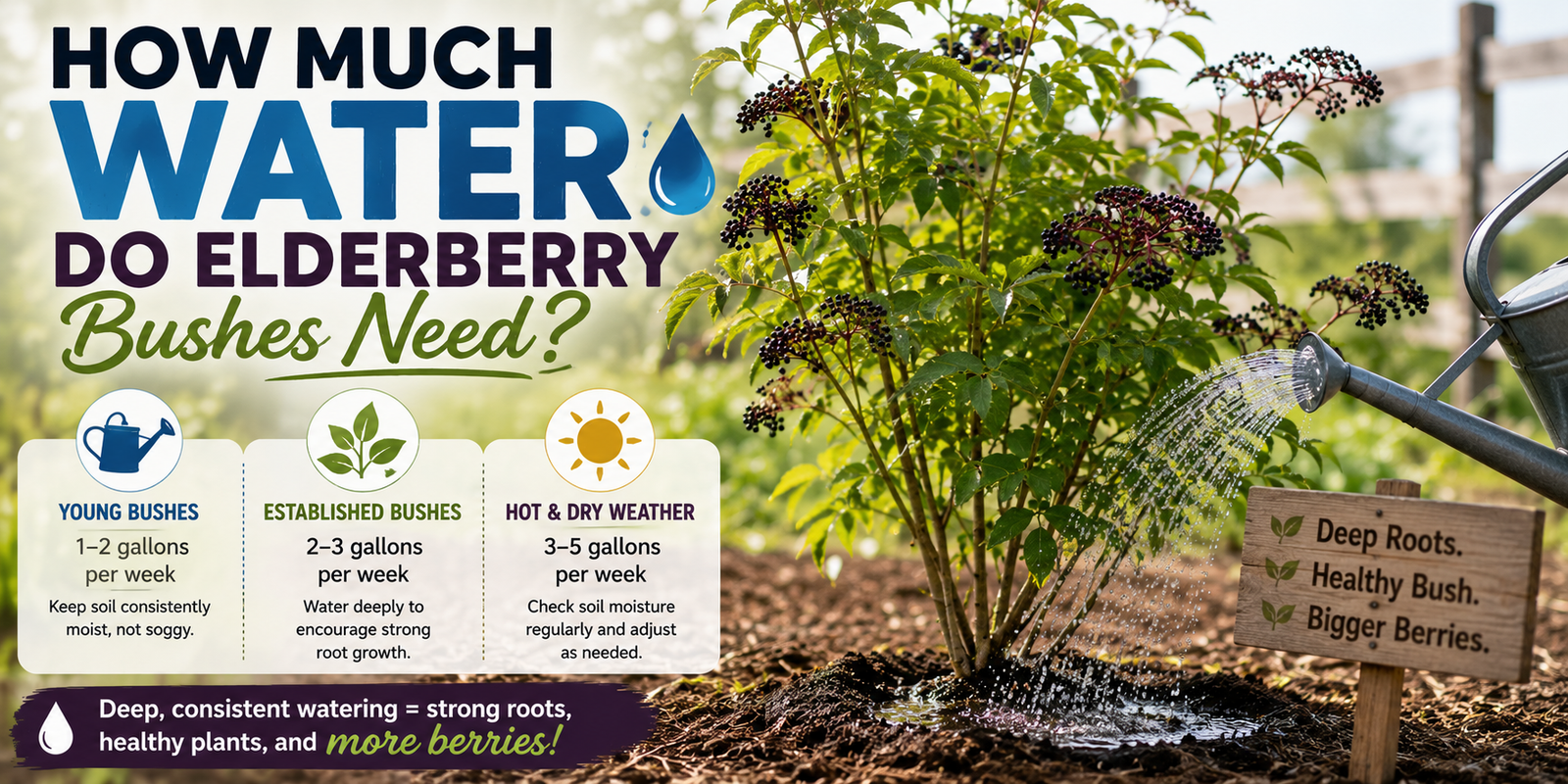
If you’re unsure what proper watering actually looks like, How Much Water Do Elderberry Bushes Need? covers that separately.
That gives you something objective to compare against rather than assuming every drooping leaf means “more water.”
Could a Disease Cause Similar Symptoms?
Absolutely.
That’s one reason I don’t diagnose elderberry borer from wilting alone.
Diseases can cause dieback.
Root problems can cause wilting.
Cankers can damage stems.
Heat can stress the plant.
Drought can cause leaves to collapse.
Excessively wet soil can damage roots.
Physical injury can interrupt a cane.
And boring insects can damage stems internally.
The difference is evidence.
A suspicious hole and internal tunneling in the same cane that’s suddenly wilting gives me a much stronger reason to suspect a borer than wilted leaves by themselves.
That’s why inspecting the cane is so important.
What If There Is No Hole?
Don’t force the borer diagnosis.
This sounds obvious, but once someone reads about a pest, it’s easy to start seeing it everywhere.
If you inspect the affected cane carefully and can’t find holes, tunneling, larvae, or other evidence of boring damage, broaden the investigation.
Check the soil.
Think about recent weather.
Inspect the roots if necessary.
Look for cankers or physical damage.
Consider whether the plant was recently transplanted.
One symptom can have multiple causes.
The goal isn’t proving that you have elderberry borer.
The goal is figuring out what’s actually wrong with your plant.
Can Borer Damage Cause a Cane to Break?
Yes.
Internal tunneling can weaken plant tissue.
A cane that has been structurally compromised may be more likely to break, particularly when carrying foliage, flowers, or heavy berry clusters.
Wind can add even more stress.
If a cane breaks and the inside looks hollowed, tunneled, or otherwise abnormal, I wouldn’t assume wind was the entire problem.
Inspect the break.
Sometimes the break simply reveals damage that was already happening inside.
Should You Seal the Hole in an Elderberry Cane?
If a larva is already tunneling inside the cane, plugging the visible hole doesn’t undo the internal damage or guarantee you’ve eliminated the insect.
I’d rather determine how extensive the damage is.
If the affected shoot or cane is clearly infested and failing, removing the damaged material is much more straightforward.
Trying to patch a dying cane because I don’t want to lose it can leave me protecting plant tissue that’s already badly compromised.
Elderberries are vigorous shrubs.
Sometimes removing one bad cane is the cleaner solution.
Will Pruning Elderberries Prevent Borers?
Pruning isn’t a guarantee that borers will never appear.
I wouldn’t sell it as one.
But good pruning helps me maintain a manageable bush that I can actually inspect.
Old, dead, damaged, or crowded growth makes it harder to see what’s happening.
A well-managed elderberry gives me better access to individual canes and makes sudden changes easier to notice.
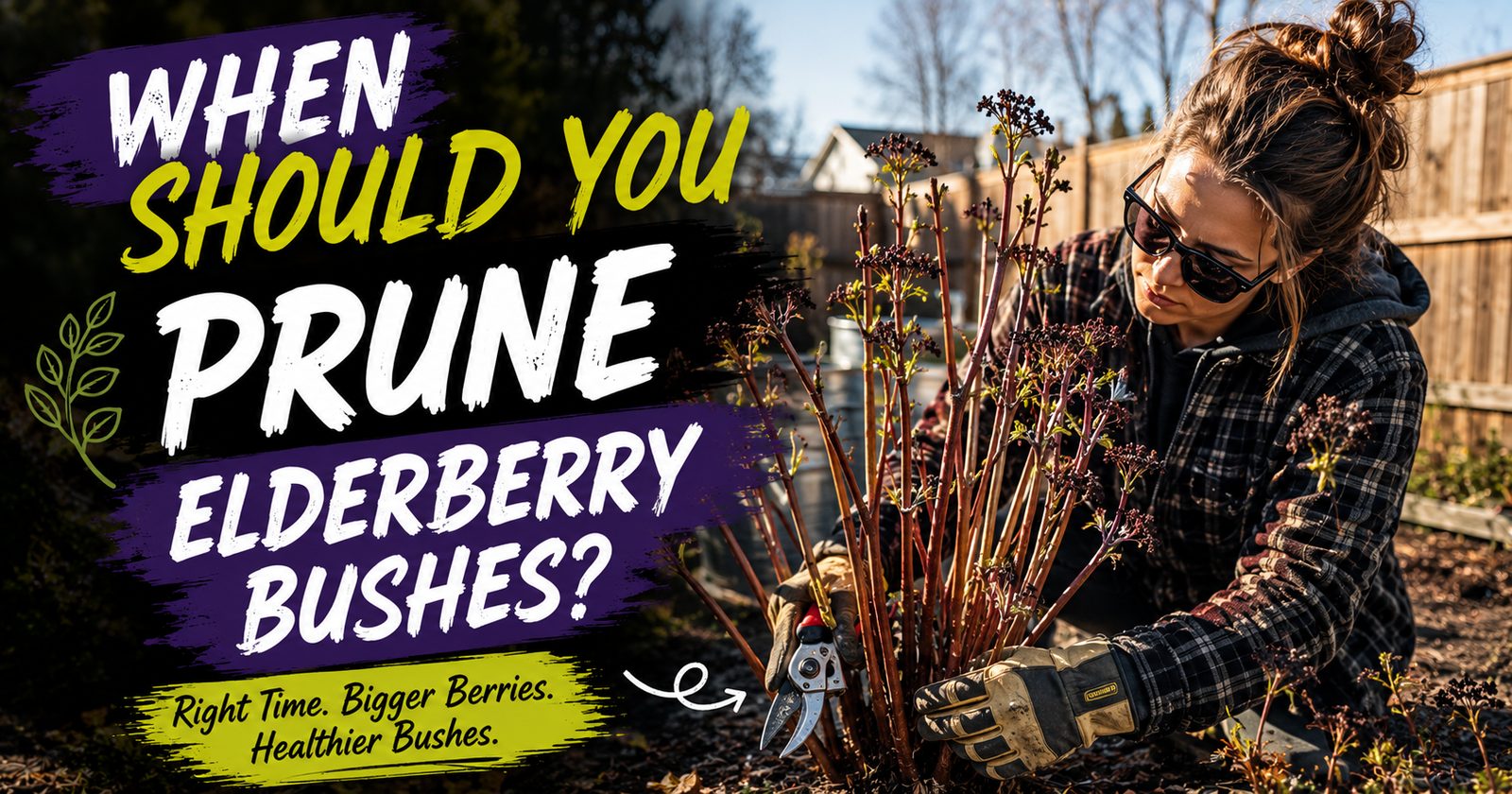
If your bush has become a tangled mass and you’re unsure what should come out, When Should You Prune Elderberry Bushes? Here’s What Works covers routine pruning separately.
That article is about normal elderberry management.
This one is about diagnosing and responding to boring insects.
Do Pruning Cuts Attract Elderberry Borers?
I wouldn’t assume every normal pruning cut becomes a borer invitation.
The Extension material supporting borer management focuses much more directly on identifying damage, removing infested shoots or canes, destroying affected material, and monitoring plants.
That doesn’t mean careless pruning is a good idea.
I still use sharp, clean tools and make purposeful cuts.
But I wouldn’t avoid necessary pruning because I’m terrified that every cut will attract a borer.
Manage the plant properly and monitor it.
Protect Pollinators While You’re Dealing With Pests
This matters especially with elderberries because the flowers attract insects we actually want.
Bees and other pollinators play an important role during flowering.
That’s another reason I don’t like the idea of spraying broad insecticides around blooming elderberries without understanding exactly what I’m targeting.
Solving one pest problem shouldn’t automatically mean creating another problem by unnecessarily exposing beneficial insects.
For a backyard grower, targeted physical removal of confirmed pests and infested plant material can sometimes be far more sensible.
If chemical control ever becomes necessary, I’d follow current label directions and locally appropriate Extension guidance for the specific pest rather than improvising.
Don’t Ignore Dead Canes
A completely dead cane isn’t contributing much to the bush.
If I find dead or badly damaged growth during inspection, I want to understand why it’s there.
Maybe it’s ordinary cane decline.
Maybe winter damage.
Maybe disease.
Maybe physical injury.
Maybe a borer.
The cause matters because it tells me whether I should simply prune the cane or start inspecting the rest of the planting for the same problem.
Dead growth is information.
I don’t want to remove it without ever looking at what happened.
Can Elderberry Borers Kill the Whole Bush?
Severe damage can obviously become more serious than losing one shoot.
But one borer-damaged cane does not automatically mean the entire elderberry is doomed.
Remember how elderberries grow.
They’re multi-stemmed shrubs capable of producing vigorous new canes and suckers.
That gives established plants some resilience.
If I catch an isolated infestation, remove the affected growth, and the remaining plant is healthy, I’m not digging up the whole elderberry out of panic.
Widespread repeated damage is different.
That’s when I’d seek a more confident pest identification and management plan.
Should You Remove the Entire Elderberry Plant?
Not because you found one damaged cane.
I’d consider whole-plant removal only in a much more serious situation where the plant itself is failing broadly and there’s a clear reason that removal is warranted.
Even then, I’d want to understand the diagnosis first.
Removing a healthy established elderberry because one shoot contained a borer would be a pretty extreme response.
Cut out the problem.
Monitor the rest.
See how the plant responds.
A Quick Elderberry Borer Check I Would Actually Use
If I walked outside tomorrow and found one elderberry cane suddenly wilted, here’s the order I’d use:
1. Look at the rest of the bush.
Is everything wilting or only one cane?
2. Check the soil.
Is it actually dry?
3. Follow the wilted cane downward.
Look closely at the stem.
4. Search for holes or damaged areas.
Don’t just inspect the leaves.
5. If the cane is clearly failing, cut into the damaged section.
Look for tunneling or larvae.
6. Remove confirmed infested growth.
Cut back below the affected area into healthy tissue.
7. Remove the infested material from the planting.
Don’t leave it under the bush.
8. Monitor neighboring canes.
Watch for another suddenly wilted shoot.
That process is simple enough that a backyard grower can actually use it.
When I’d Ask Extension for Help
There is no shame in getting an insect identified.
In fact, I’d rather send clear photographs to someone who knows local pests than spend $60 spraying random products at the wrong insect.
Your local Cooperative Extension office may be able to help identify:
the adult beetle,
a larva,
the type of tunneling,
or the pattern of damage.
Take good pictures before disposing of everything.
If possible, photograph the insect beside something that gives a sense of scale.
The more information you provide, the easier identification becomes.
One Wilted Cane Is a Clue, Not a Death Sentence
This is probably the biggest thing I’d want an elderberry grower to take away from the article.
When one cane suddenly collapses, don’t immediately assume the whole bush is dying.
And don’t immediately assume it needs more water.
Look closer.
Elderberries are multi-stemmed plants, which means one damaged cane can behave very differently from the rest of the bush.
A tiny hole in the stem may explain what looked like a mysterious watering problem.
Finding that evidence changes what you do next.
Instead of soaking the soil, fertilizing randomly, or spraying everything in sight, you can remove the damaged cane and monitor the healthy growth that remains.
That’s the kind of troubleshooting I prefer.
Observe first. Identify second. Treat third.
A healthy elderberry can be remarkably resilient when you catch problems early and respond to what the plant is actually showing you.
About the Author
Avery Collins writes about growing, troubleshooting, propagating, and harvesting elderberries for Elderberry Pro. Avery focuses on practical backyard-growing information that helps gardeners identify what their plants are actually showing them before reaching for unnecessary treatments.