

The little elderberry plant you bring home can be incredibly misleading.
It might be sitting in a nursery pot looking like it would fit just about anywhere.
Beside the porch?
Sure.
Three feet from another shrub?
Looks like plenty of room.
Tucked into a little opening along the fence?
Why not?
Then the plant gets established.
New canes appear.
Branches arch outward.
Suckers start popping up.
And suddenly that innocent little elderberry isn’t so little anymore.
That’s why I think mature size is something every gardener should consider before planting an elderberry bush.
These aren’t tiny berry shrubs.
Given enough time and good growing conditions, an American elderberry can become a substantial, wide, multi-stemmed shrub that occupies considerably more room than the original nursery plant suggests.
How Big Do Elderberry Bushes Get?
A mature American elderberry can commonly reach roughly 5 to 12 feet tall and 6 to 12 feet wide, depending on the plant, growing conditions, pruning, and how much spreading you allow.
I think the width surprises people more than the height.
It’s easy to picture a bush growing upward.
It’s harder to imagine how much room a mature elderberry can occupy once multiple canes begin arching outward and new shoots emerge around the original crown.
An unmanaged elderberry isn’t necessarily going to remain one tidy little round bush.
It naturally wants to become a broad, multi-stemmed plant.
And if suckers are allowed to continue developing around it, one original planting can gradually begin looking more like an elderberry patch.



How Tall Do American Elderberry Bushes Get?
American elderberries commonly mature somewhere around 5 to 12 feet tall.
That’s taller than many people expect when they’re looking at a young plant.
At the upper end, you’re dealing with something roughly as tall as a one-story room or higher.
That doesn’t mean every elderberry in every yard will reach exactly 12 feet.
Growing conditions make a difference.
Variety matters.
Pruning matters.
Plant age matters.
Sunlight, moisture, soil, and competition from surrounding plants can all influence growth.
But if you’re choosing a permanent planting location, I wouldn’t plan around the three-foot bush you have today.
I’d plan around the large shrub it can become.

How Wide Do Elderberry Bushes Get?
This is where I’d leave more room than you think you need.
American elderberries can commonly spread roughly 6 to 12 feet wide.
That doesn’t mean every branch will stop at an invisible six-foot circle around the plant.
Elderberries have an arching, spreading growth habit.
Some canes lean outward.
New shoots emerge.
And suckers can expand the footprint beyond the original crown.
So when I think about elderberry width, I’m not only thinking about the longest branch.
I’m thinking about the entire space the plant is going to occupy once it matures.
That matters when you’re planting near:
fences,
walkways,
other fruit plants,
garden beds,
buildings,
or another elderberry.
Elderberries Aren’t Naturally Neat Little Shrubs
If you’re imagining something that naturally maintains a perfect ornamental shape, elderberry may surprise you.
American elderberries are multi-stemmed shrubs.
New canes emerge from around the crown, and the overall plant can develop an open, arching appearance.
I actually like that about them.
They look natural.
But that growth habit means I wouldn’t squeeze one into a location where every branch needs to remain perfectly contained.
You can manage elderberries with pruning.
You can remove unwanted suckers.
You can keep the plant more controlled.
But you’re working with its natural growth habit rather than changing what the plant fundamentally wants to do.



How Fast Do Elderberry Bushes Grow?
Elderberries can grow surprisingly quickly once they’re established.
I wouldn’t judge their eventual size by what happens immediately after planting.
The first season can involve a lot of root establishment.
Once the root system becomes established, new canes can grow vigorously.
That’s when the plant starts changing quickly.
One season it may still look relatively modest.
A couple of growing seasons later, you can be looking at a completely different shrub.
This is why giving elderberries adequate room from the beginning is so much easier than trying to solve a cramped planting several years later.
How Big Will an Elderberry Be After One Year?
There’s no reliable universal measurement for a one-year-old elderberry.
A newly planted bush may spend much of its first season establishing roots while still producing visible top growth.
The starting plant matters too.
A tiny rooted cutting isn’t beginning from the same place as a larger nursery plant with an established root system.
Weather matters.
Water matters.
Planting date matters.
So I wouldn’t tell someone:
Your elderberry will be exactly four feet tall after one year.
Plants don’t work like that.
Instead, I think of the first year as establishment.
I’m trying to create the conditions that allow the plant to become vigorous later.



What About After Two or Three Years?
This is when things can become much more interesting.
Once elderberries establish strong root systems, they can begin producing additional canes and suckers around the original plant.
The bush starts filling out.
Its footprint expands.
Flowering and berry production may increase.
And suddenly the amount of space you originally gave it starts mattering.
That’s why I don’t plant elderberries based on their first-year appearance.
I’m thinking about where those plants will be several years from now.

If you’re wondering when all of that growth actually begins producing worthwhile fruit, How Long Does It Take an Elderberry Bush to Produce Fruit? covers the fruiting timeline separately.
Size and fruit production are related parts of maturity, but they’re not exactly the same question.
Elderberries Can Spread Through Suckers
This is probably the most important thing to understand about elderberry size.
The plant doesn’t necessarily stay confined to the exact spot where you planted the original stem.
American elderberry naturally produces suckers.
Those are new shoots emerging from the root system around the established plant.
Leave them alone and they can become additional canes.
Keep leaving them alone over the years and the planting can gradually expand.
That’s how elderberries can form thickets in natural areas.
Whether that’s good or annoying depends entirely on what you wanted.


Is Elderberry Invasive?
I wouldn’t casually label American elderberry an invasive plant in its native range.
American elderberry is native across a large portion of North America.
But native doesn’t mean incapable of spreading aggressively around your yard.
That’s an important distinction.
An elderberry can sucker vigorously and colonize an area without being an invasive exotic species.
If you plant it somewhere that allows natural spreading, that may be exactly what you want.
If you put it in a tiny formal landscape bed and expect it to remain inside a perfectly defined three-foot circle forever, you’ll probably spend more time managing it.
Will One Elderberry Bush Turn Into Several?
It certainly can begin looking that way.
As suckers develop around the original crown, you may end up with multiple shoots emerging from the surrounding area.
Eventually, the distinction between “one bush” and “a patch of elderberry canes” becomes less obvious.
That’s normal elderberry behavior.
It also gives us a completely separate future topic worth covering because gardeners often wonder whether those suckers should be removed, transplanted, or allowed to grow.
For this article, the important point is simply:
Plan for more than the width of the original crown.



How Far Apart Should Elderberry Bushes Be?
Once you understand mature size, spacing recommendations make much more sense.
If two plants can each become broad shrubs, putting them almost on top of one another creates competition and makes harvesting, pruning, and moving between them harder.
Commercial spacing and backyard spacing aren’t necessarily identical because commercial growers may use specific pruning systems, equipment, varieties, and row layouts.
For a home planting, I want enough room for mature plants to develop without immediately becoming one tangled mass.
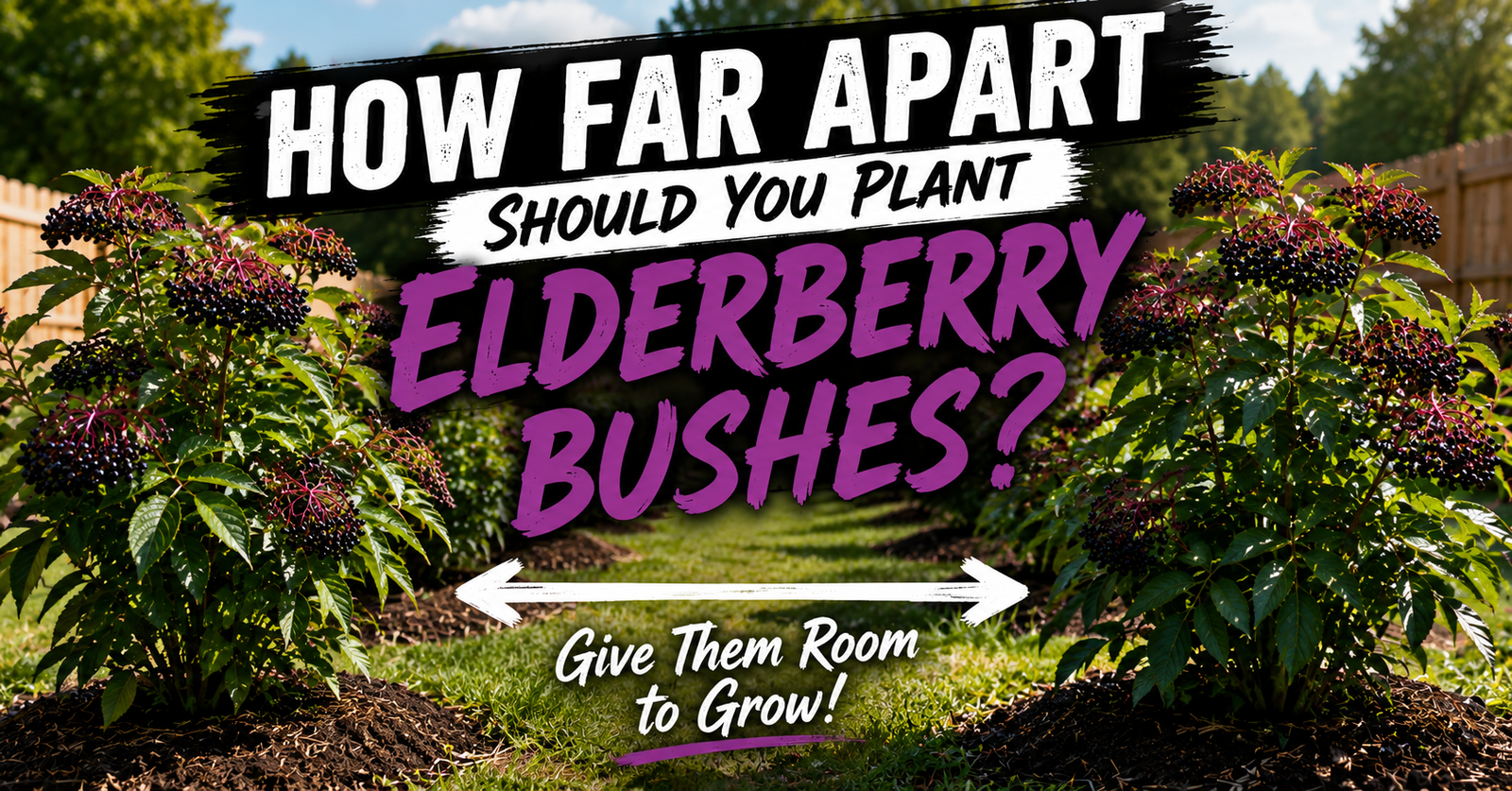
I’ve covered that question separately in How Far Apart Should You Plant Elderberry Bushes? so we don’t need to turn this size guide into another spacing article.
But the reason spacing matters begins with mature size.
A plant that can become 10 feet wide deserves more planning than a two-foot perennial.
How Close Can You Plant Elderberry to a House?
I wouldn’t plant one directly against the foundation simply because the young plant fits there today.
Think about access.
Can you still walk around the mature bush?
Can you prune it?
Can you harvest berries?
Can you reach the siding?
Can you clean or maintain whatever is behind it?
Are arching branches going to end up lying against the house?
And what happens when suckers appear?
There’s no single magic number that applies to every house and every elderberry variety.
But I want enough room that the mature plant can exist without becoming an obstacle.
Plant for the future shrub, not today’s nursery pot.
What About Planting Beside a Fence?
A fence can actually make a useful backdrop for elderberries, but again, I wouldn’t cram the plant directly against it.
Leave yourself room.
At some point, you may need to get behind the plant.
You may need to repair the fence.
You may need to remove a cane.
You may want to harvest fruit from the back side.
An elderberry that has grown through and around a fence for five years isn’t going to make any of those jobs easier.
Think about maintenance access before planting.
Future you will appreciate it.
Can You Keep an Elderberry Bush Small?
Yes, to a point.
Elderberries respond well to pruning, and managing older canes and unwanted suckers can keep the plant more controlled.
That doesn’t mean I’d take a naturally large shrub and expect to maintain it permanently as a tiny two-foot ornamental.
Choose a plant that fits the space you’re working with.
Then use pruning to manage it.
Don’t choose a space that’s fundamentally too small and assume pruning will solve everything forever.
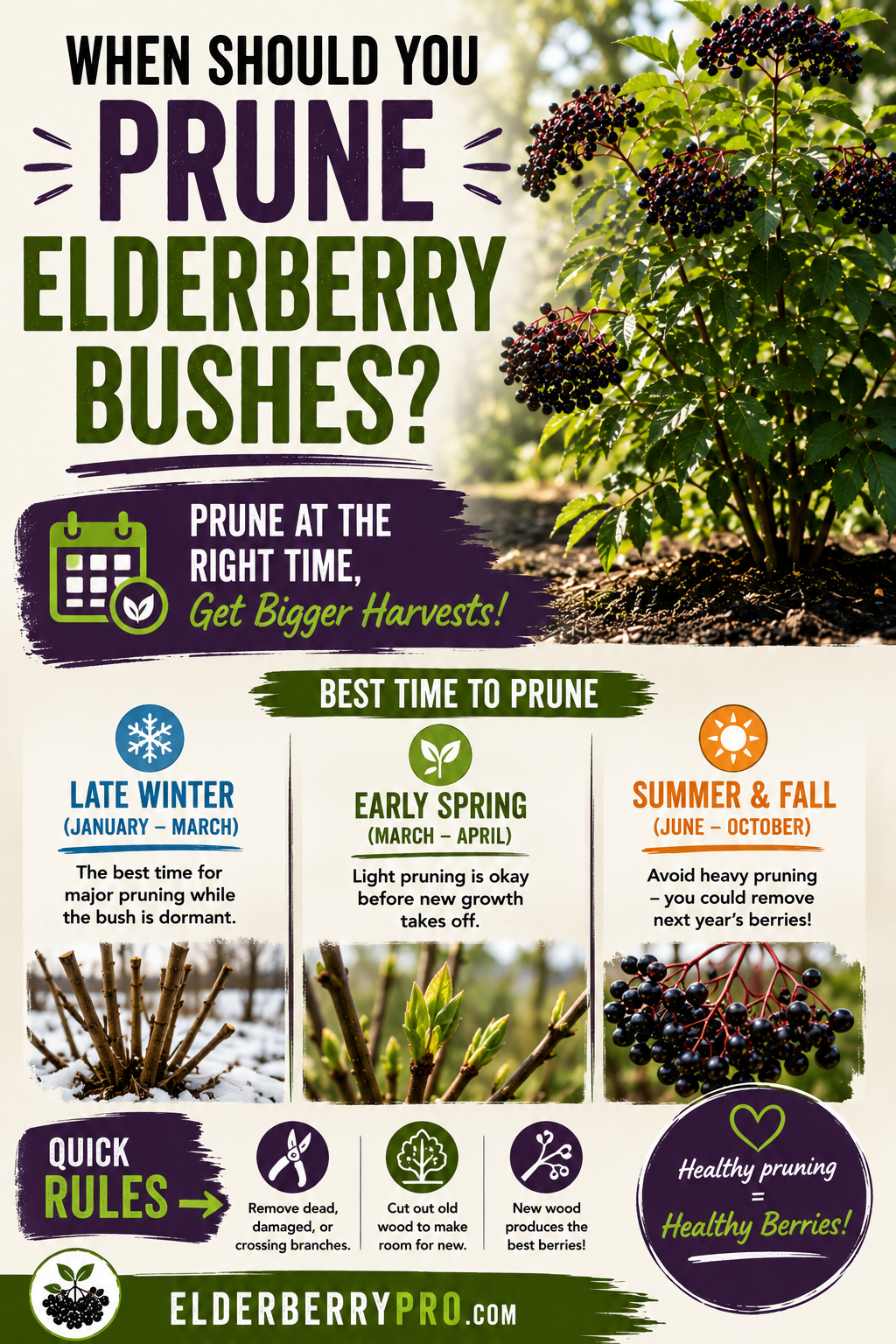
If controlling mature size is one of your main concerns, When Should You Prune Elderberry Bushes? goes into the pruning side in detail.
That’s the better place to learn what should actually be removed and when.
Does Pruning Make Elderberries Produce Less Fruit?
This is where pruning becomes more than simply making the bush fit a space.
You’re managing fruiting wood too.
Elderberries produce fruit on canes, and pruning decisions can influence the amount and location of future growth and fruiting.
That’s why I don’t randomly attack an oversized elderberry with hedge trimmers in the middle of the season simply because it looks too large.
Size management should be planned.
If I know from the beginning that I want a more controlled plant, regular annual management makes much more sense than ignoring it for five years and then trying to dramatically shrink it all at once.
How Big Do Elderberries Get in Containers?
Growing an elderberry in a container changes how much room its roots have available, but it doesn’t suddenly turn a naturally vigorous shrub into a tiny patio plant.
Container size, pruning, nutrients, water, and root space all influence how large the plant can become.
The biggest mistake I’d avoid is putting an elderberry into a small decorative pot and assuming it can stay there permanently.
A young plant may look perfectly comfortable.
Then the roots fill the container.
Water disappears faster.
Growth becomes harder to manage.
And suddenly you’re deciding whether to move the plant into something much larger or finally put it in the ground.
Container growing can absolutely work, but it requires more active size management than giving an elderberry a roomy permanent location in the yard.

If that’s how you’re planning to grow yours, my complete guide to growing elderberries in pots covers container size, drainage, watering, fertilizer, pruning, winter care, and eventually dealing with a root-bound plant.
Does Full Sun Make Elderberry Bushes Grow Bigger?
Growing conditions absolutely influence vigor.
An elderberry receiving adequate sunlight, moisture, nutrients, and room has a better opportunity to reach its potential than a plant constantly struggling with poor conditions.
But I wouldn’t deliberately put an elderberry somewhere unsuitable simply because I want to keep it smaller.
A struggling plant isn’t the same thing as a well-managed compact plant.
If mature size worries me, I’d rather give the elderberry healthy growing conditions and manage its size intentionally through pruning and sucker control.
That’s much better than trying to stunt it.
What Happens to Elderberry Size in Partial Shade?
Elderberries can tolerate some shade, but reduced sunlight can influence growth and fruit production.
The tricky part is that a plant growing in shade doesn’t necessarily remain conveniently small and compact.
Plants sometimes stretch toward available light, and you can end up with weaker or leggier growth rather than the neat miniature elderberry you imagined.
So I wouldn’t use shade as my size-control strategy.

If you’re deciding between planting locations, Can Elderberries Grow in Shade? Here’s What I Learned goes into the sunlight question separately.
For mature size, I’d still assume the plant needs substantial room.
How Much Room Would I Actually Give One Elderberry Bush?
If I were choosing a planting location today, I’d visualize a shrub roughly 10 feet across.
Not because every elderberry will become exactly 10 feet wide.
It won’t.
But that mental picture forces me to think realistically.
Would a 10-foot shrub block the walkway?
Would it cover the window?
Would it swallow a nearby garden bed?
Would I still be able to mow around it?
Could I get behind it to harvest?
Would it interfere with a gate?
Would another elderberry planted nearby create one enormous tangled mass?
Those questions are much more useful than staring at a young two-foot plant and guessing.
Don’t Forget the Space You Need Around the Bush
The plant itself isn’t the only thing that needs room.
You need room too.
Eventually, you may want to walk around the elderberry.
Prune it.
Harvest flowers.
Pick berry clusters.
Install bird netting.
Remove old canes.
Control suckers.
Inspect a problem branch.
If the plant technically fits but you can’t get anywhere near half of it, the location isn’t as convenient as it looked on planting day.
I like leaving working room around food-producing plants whenever possible.
Mature Size Matters When You Start Harvesting
A ten-foot elderberry sounds impressive until the best berry clusters are hanging somewhere you can’t conveniently reach.
That’s another reason I don’t automatically think bigger is always better.
I want vigorous plants.
But I also want manageable plants.
Regular pruning can help keep berry-producing growth accessible instead of allowing the shrub to become an enormous mass of old and new canes.
Planning for harvest access from the beginning makes everything easier later.
Big Elderberry Bushes Can Make Bird Protection Harder
There’s another practical consequence to allowing an elderberry to become enormous.
Bird netting gets more difficult.
Protecting a moderately sized shrub is one thing.
Trying to cover a sprawling twelve-foot elderberry after birds discover the fruit is something else entirely.
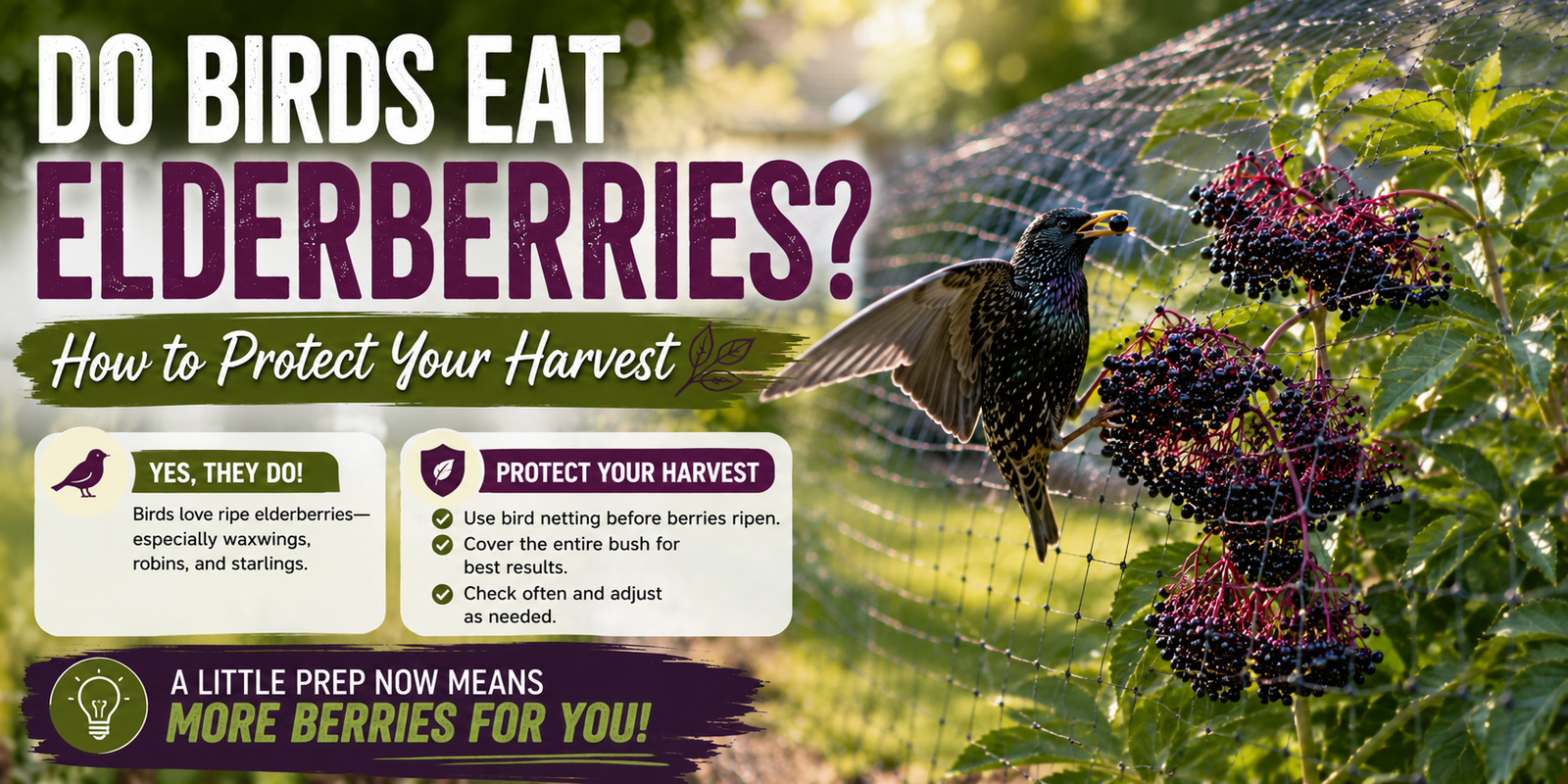
Large bushes can absolutely produce impressive crops, but those crops aren’t very useful if every bird in the neighborhood eats them before you can harvest.
That’s another reason manageable size can sometimes be more valuable than maximum size.
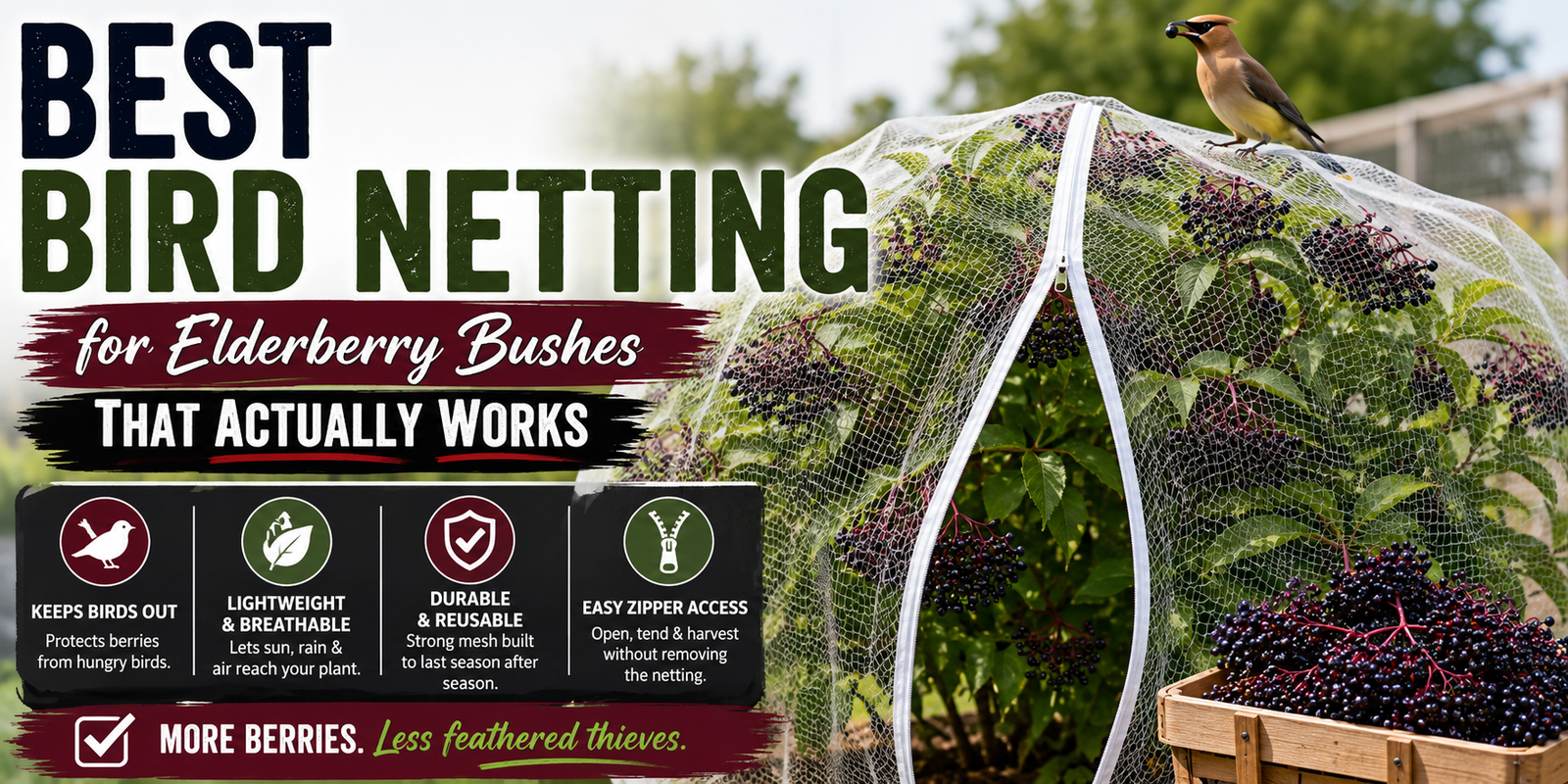
If wildlife pressure becomes a problem, Best Bird Netting for Elderberry Bushes That Actually Works covers the protection side separately.
Should You Let Elderberry Suckers Grow?
That depends entirely on what you’re trying to create.
If I want a broad naturalized elderberry patch, some suckering may be welcome.
If I want one controlled shrub occupying a defined part of the yard, I’m going to manage those suckers.
That’s the difference.
Suckers aren’t automatically a sign something is wrong.
They’re part of how elderberry naturally spreads.
But every sucker you allow to mature adds more growth to the planting.
Ignore them long enough and the footprint can expand well beyond the original plant.
Can You Remove Elderberry Suckers?
Yes, unwanted suckers can be removed as part of managing the planting.
The earlier you decide what you want, the easier that management becomes.
I don’t want to wait until a sucker has become another large established cane before deciding it was growing somewhere inconvenient.
Watch the area around the plant.
If new shoots are appearing where you don’t want elderberries expanding, deal with them while they’re manageable.
And don’t confuse sucker removal with something being wrong with the plant.
A vigorously suckering elderberry may simply be doing exactly what elderberries naturally do.
Could You Use the Suckers to Grow More Elderberries?
Potentially, and that’s one reason I don’t automatically look at every sucker as waste.
A healthy sucker with suitable roots may offer an opportunity to establish another plant elsewhere.
That deserves its own article because moving rooted suckers isn’t exactly the same thing as rooting stem cuttings.
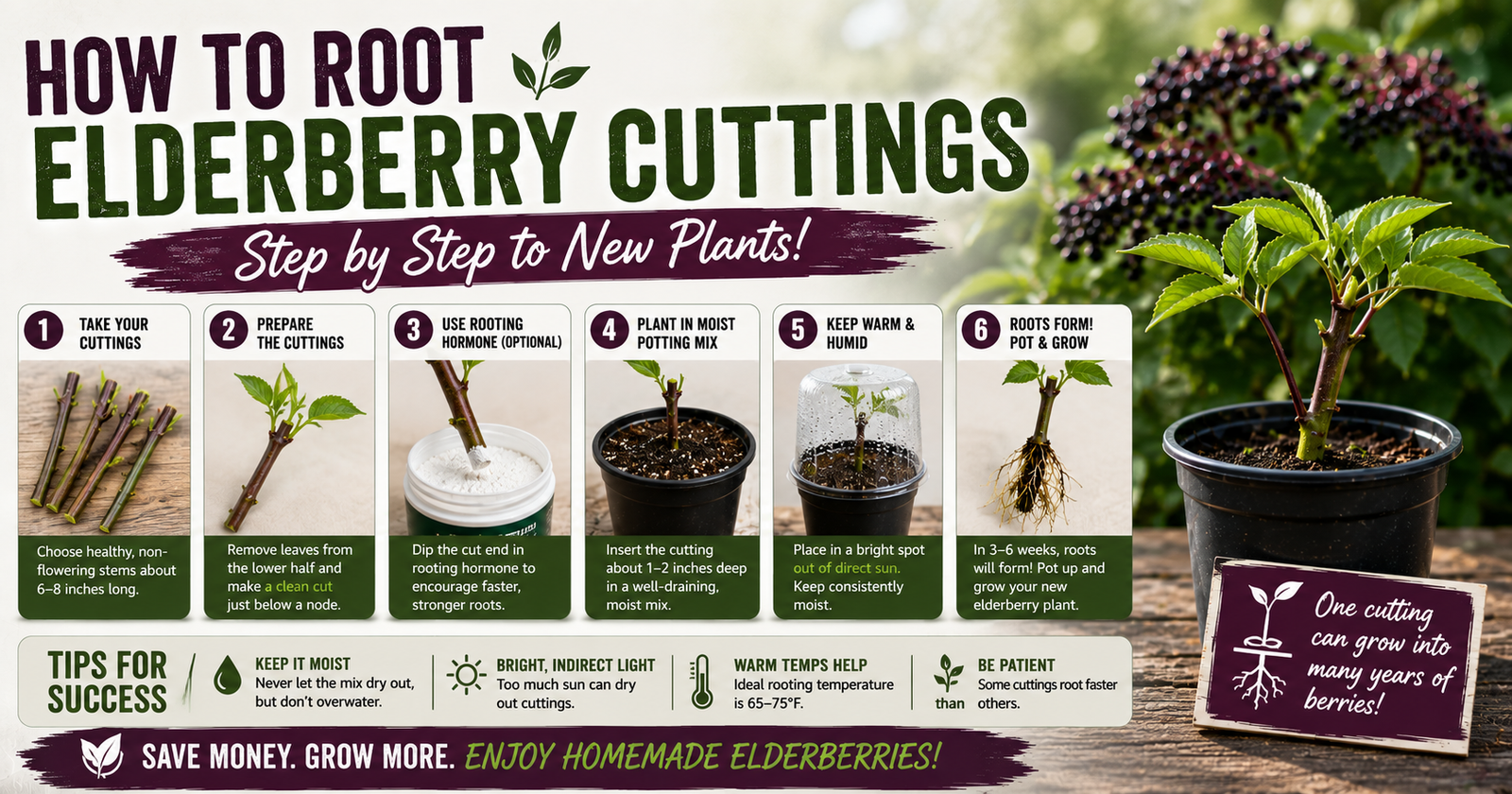
We already have a complete propagation cluster about growing elderberries from cuttings, and I don’t want to cram a second propagation method into a size article.
For now, just know that the spreading growth around an established elderberry isn’t always useless.
Sometimes the plant is essentially offering you material for expansion.
Do Different Elderberries Reach Different Sizes?
Yes.
“Elderberry” describes a group of plants, not one genetically identical shrub growing everywhere.
Species and cultivars can differ in mature size, growth habit, foliage, flowering, and fruit characteristics.
American elderberry is the main plant I’m discussing here because it’s the elderberry I focus on most heavily throughout Elderberry Pro.
If you’re buying a named cultivar, read the nursery’s mature-size information for that particular plant rather than assuming every elderberry will behave identically.
That’s especially important if you’re choosing a plant for a tight landscape.
General species information gives you expectations.
Cultivar information helps you make the final decision.
American Elderberry vs European Elderberry Size
American elderberry and European elderberry aren’t identical plants.
Both can become substantial shrubs, and both deserve adequate room.
European elderberry can also develop into a large shrub or small tree under suitable conditions, depending on the cultivar and how it’s managed.
That’s why I wouldn’t use the word “elderberry” alone to determine exactly how much space a particular plant needs.
Know what species and cultivar you’re actually planting.
Then plan around that plant’s expected mature dimensions.
Are Elderberry Roots Dangerous Near Foundations?
I wouldn’t describe elderberry as a giant tree with the kind of massive woody root system people often worry about lifting pavement or threatening structures.
But that still doesn’t give me a reason to plant one directly against a foundation.
The bigger practical problems are the shrub itself and its suckering habit.
I want room to maintain the house.
I want airflow.
I want access.
I don’t want new shoots appearing somewhere inconvenient.
And I don’t want mature branches constantly lying against siding or blocking a window.
Sometimes good planting distance isn’t about fearing catastrophic root damage.
It’s simply about leaving enough room for both the plant and the building.
Can Elderberries Be Used as a Privacy Screen?
They certainly can create substantial seasonal screening once mature.
A row of vigorous elderberries can become thick and leafy during the growing season.
But I’d remember that elderberries are deciduous.
They lose their leaves.
So if you’re looking for a dense green privacy wall twelve months of the year, elderberry isn’t an evergreen hedge.
During the growing season, though, their height, width, and fast growth can make them useful for screening while also giving you flowers and fruit.
That’s a pretty nice combination if the location makes sense.
Can You Make an Elderberry Hedge?
Yes, although I’d think carefully about how much maintenance I want.
Closely planted elderberries can eventually grow together visually.
That may be exactly what you want along a property edge or in a more naturalized planting.
But remember what comes with that:
More canes.
More suckers.
More pruning.
More fruit.
More bird pressure.
And potentially less access to the interior of the planting.
A hedge can be productive and beautiful.
It just isn’t maintenance-free.
What If Your Elderberry Is Already Too Big?
Don’t panic and don’t necessarily cut everything to the ground in the middle of the growing season because you suddenly realized the bush is enormous.
First decide what the actual problem is.
Is it too tall?
Too wide?
Are suckers spreading somewhere unwanted?
Are old canes making the center crowded?
Is it blocking access?
Different problems call for different management.
Then use the appropriate pruning season to reshape and renew the plant rather than reacting with random cuts.
Elderberries are vigorous plants.
That’s an advantage when you manage them intentionally.
Bigger Isn’t Always Better
I like vigorous elderberries.
I want healthy canes.
I want flowers.
I want big berry clusters.
But I don’t need the largest elderberry bush physically possible.
I need one that fits the property and remains practical to care for.
A slightly smaller, well-managed elderberry that I can prune, protect, and harvest may be much more useful than a giant unmanaged thicket where half the fruit belongs to the birds because I can’t reach it.
That’s why mature size isn’t simply an interesting number.
It affects almost everything you do with the plant later.
Think Ten Feet, Not Two Feet
If there’s one thing I’d want someone to remember before planting an elderberry, it’s this:
Don’t plan around the plant you’re holding today.
That little nursery elderberry may eventually occupy a space roughly comparable to a small room.
It can grow upward.
It can spread outward.
It can produce new canes.
It can sucker beyond the original crown.
And it can become a substantial landscape plant surprisingly quickly once established.
Give it room.
Give yourself room to work around it.
And if you don’t have that much space, plan from the beginning to manage the plant through pruning and sucker control.
Elderberries are incredibly rewarding shrubs when they’re planted somewhere their mature size actually makes sense.
The mistake isn’t growing a big elderberry.
The mistake is discovering five years later that you planted a big elderberry where you only had room for a little bush.
About the Author
Avery Collins writes about growing, propagating, harvesting, and using elderberries for Elderberry Pro. Avery focuses on practical backyard-growing information that helps gardeners understand what elderberry plants actually need before small nursery plants become large, productive shrubs.