
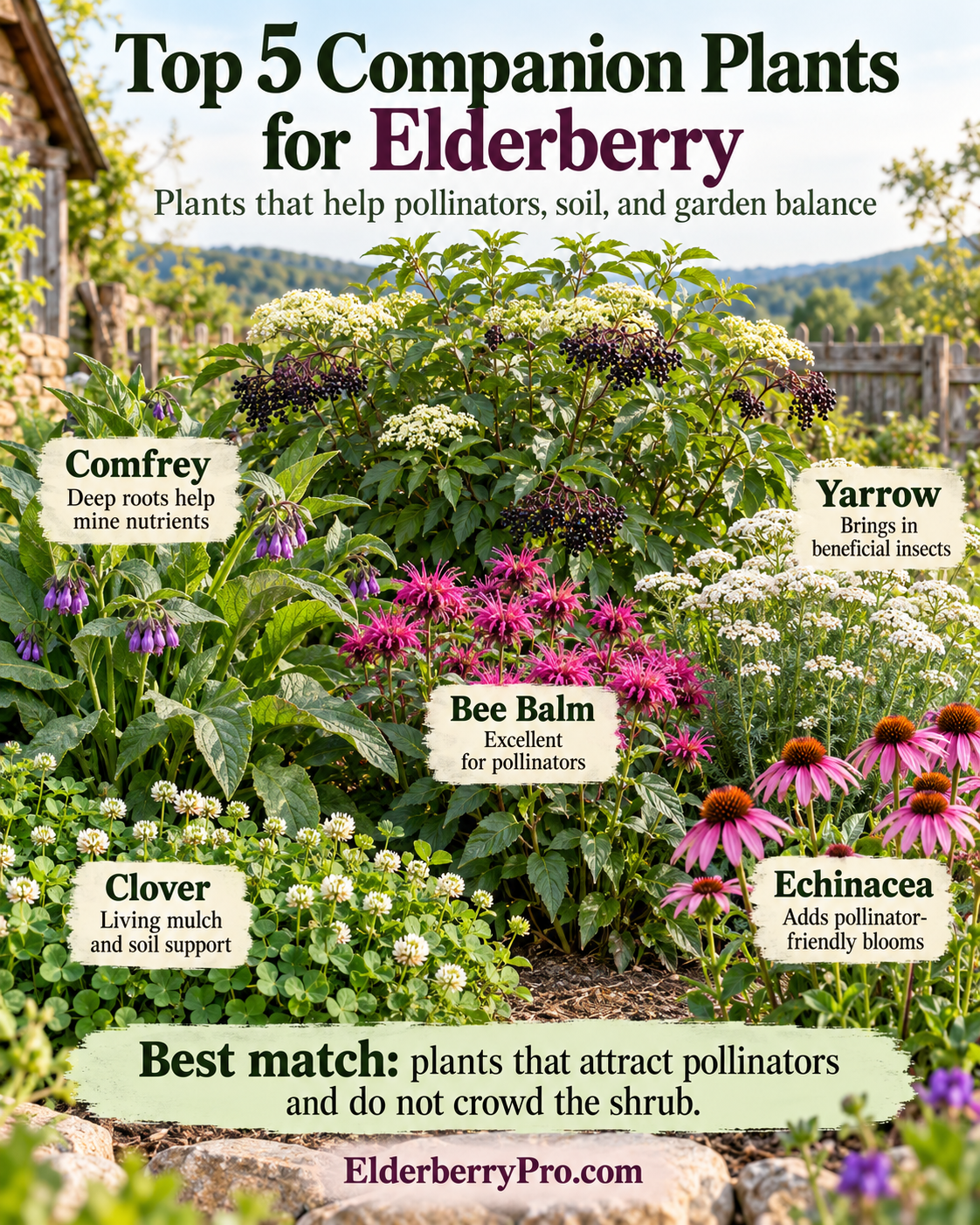
When I started looking into companion plants for elderberries, I noticed something pretty quickly.
There are a lot of very confident lists online.
Plant this beside elderberry because it “boosts growth.”
Plant that because it “repels pests.”
Never plant this other thing because the two plants supposedly hate each other.
The problem is that a lot of those claims are repeated from one gardening website to another without much evidence that anyone actually tested those combinations with elderberries.
So I look at elderberry companion planting differently.
I want plants that make sense because of how elderberries actually grow.
They like moisture.
They develop relatively shallow root systems.
They can become large shrubs.
They sucker.
They eventually create shade.
Their flowers and surrounding habitat can support insects and wildlife.
Once you understand those things, choosing what to plant nearby becomes much easier.
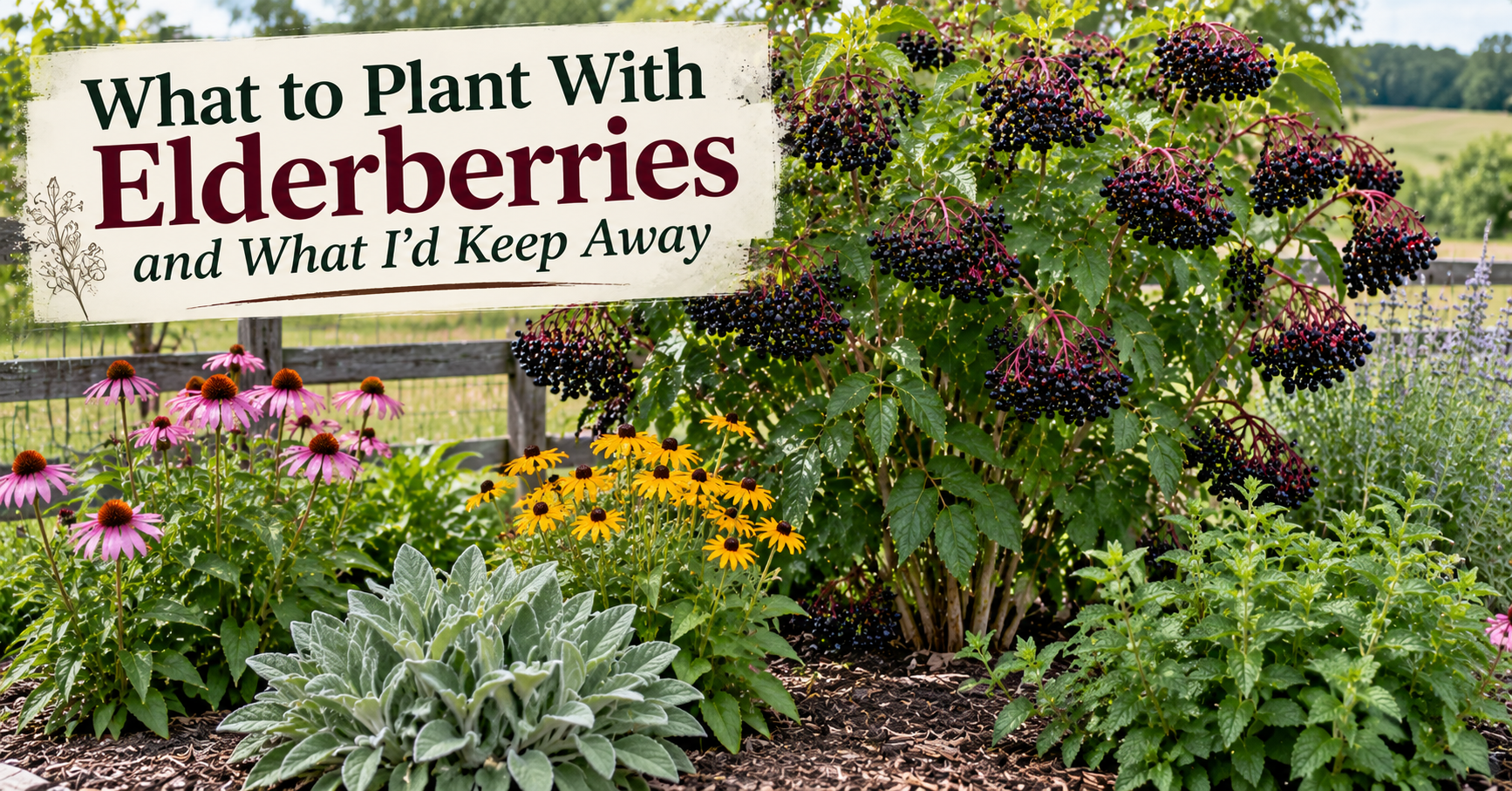
What Are the Best Companion Plants for Elderberries?
The best plants to grow near elderberries are generally ones that can handle similar growing conditions without creating unnecessary competition.
I’d look for plants that:
- Tolerate the moisture level around the elderberry.
- Fit underneath or around the mature shrub without becoming hopelessly crowded.
- Don’t require constant deep digging around elderberry roots.
- Support pollinators or other beneficial insects.
- Don’t aggressively overwhelm a young elderberry.
- Still make sense after the elderberry becomes much larger.
That last point is easy to forget.
Your companion planting plan needs to work with the mature elderberry, not just the two-foot plant you’re looking at today.



First, Remember How Big an Elderberry Gets
This changes everything.
American elderberry isn’t a tiny blueberry bush.
A mature plant can become a substantial multi-stemmed shrub, and its branches may spread many feet across.
It can also send up suckers around the original crown.
That means a beautiful little perennial planted twelve inches from a young elderberry may eventually find itself underneath a wall of elderberry growth.
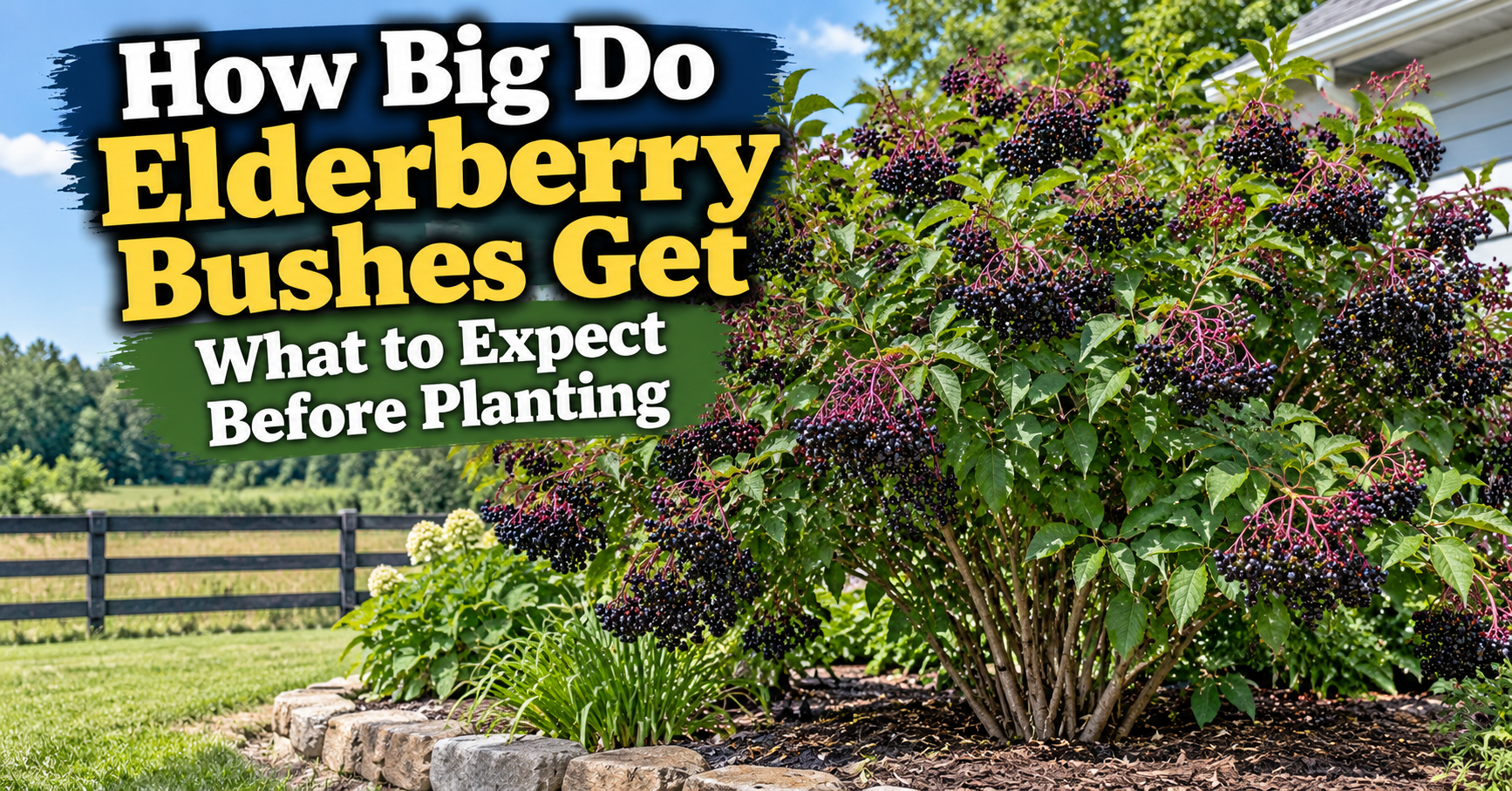
Before filling the area around a new plant, I’d read How Big Do Elderberry Bushes Get? and picture the mature shrub first.
Then design around that footprint.
Native Flowers Are One of My Favorite Choices
If I have open space around an elderberry planting, native flowering plants make a lot of sense.
Not because I’m claiming one specific flower magically doubles the elderberry harvest.
I like them because diverse flowers can provide food and habitat for beneficial insects throughout the growing season.
Elderberry flowers are available for a relatively short period.
A planting containing flowers that bloom before, during, and after elderberry flowering gives insects more reasons to remain in the area.
That’s a practical ecological benefit.
Elderberry Pollination Is More Complicated Than “Plant Flowers for Bees”
This deserves clarification because companion-plant lists often oversimplify it.
Elderberry pollination isn’t understood as neatly as something like apple pollination.
Missouri Extension describes elderberries as being primarily wind-pollinated with some insect assistance and notes that planting more than one cultivar is likely beneficial.
So I would not tell you:
Plant these five flowers and your elderberry crop will double.
That’s not evidence-based advice.
Flowering plants can support a diverse insect community.
But if berry production is your concern, having compatible elderberry cultivars nearby is much more directly relevant than finding a supposed magical companion flower.
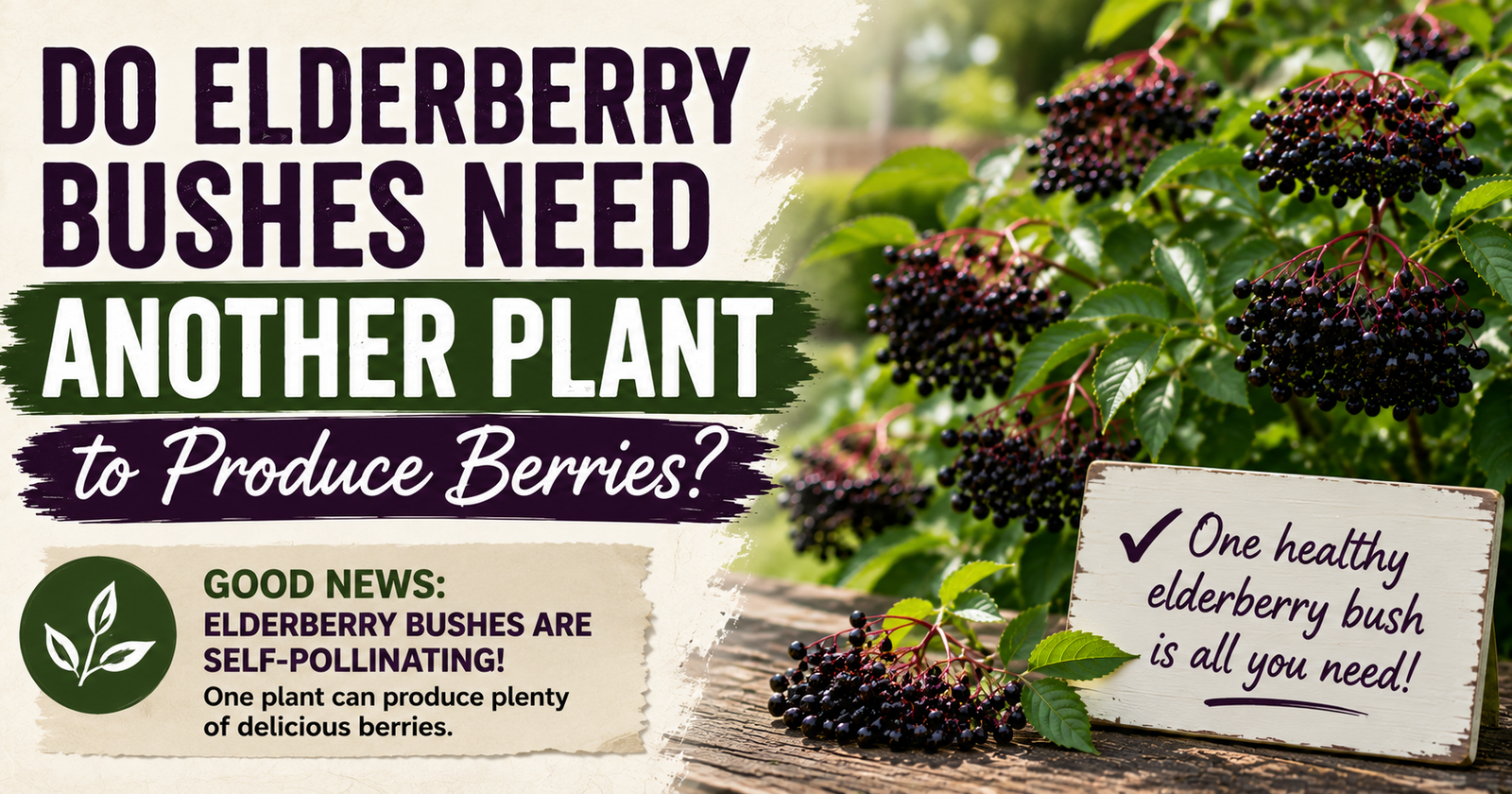
My guide on whether elderberry bushes need another plant to produce berries covers that question separately.
Yarrow Can Make Sense in a Larger Mixed Planting
Yarrow is one plant I’d consider around a larger elderberry planting.
It’s a flowering perennial that can support insects and works well in naturalized designs.
But placement matters.
California elderberry guidance specifically notes that spreading species such as yarrow may migrate away from increasing shade as larger shrubs mature.
I actually like that example because it demonstrates what real companion planting looks like.
The planting changes.
The elderberry gets bigger.
Shade increases.
Smaller plants respond.
A companion planting isn’t a static arrangement that looks identical forever.
Don’t Put Every Companion Directly Under the Elderberry
This is another thing I think companion-plant lists get wrong.
“Companion” doesn’t have to mean:
Six inches from the trunk.
A plant can benefit the overall garden ecosystem while growing several feet away.
In fact, with a large shrub like elderberry, that often makes more sense.
You need access for:
pruning,
harvesting,
sucker management,
inspection,
and eventually bird protection.
If the entire base of the elderberry is packed with plants, every one of those jobs becomes harder.
Leave yourself working room.

Elderberry Roots Are Relatively Shallow
This affects what I want growing nearby.
Elderberries obtain much of their moisture and nutrition from relatively shallow soil.
That means I’m cautious about creating intense root competition immediately around the plant.
I’m especially careful while a young elderberry is becoming established.
A mature elderberry can compete much more effectively than a newly planted one.
If I’ve just planted an elderberry, my priority is getting that plant established.
I’m not trying to create an instant botanical jungle around it.
Mulch May Be Better Than a Living Companion Right Beside the Plant
Sometimes the best thing near an elderberry isn’t another plant.
It’s mulch.
Organic mulch can help conserve moisture and suppress weeds.
That’s incredibly useful around a shallow-rooted, moisture-loving shrub.
It also gives me a clean area around the crown where I can see new suckers, inspect canes, and work around the plant.
I can still grow flowering companions farther out.
I don’t need living plants occupying every square inch of soil.



What About Clover?
Clover frequently appears on companion-plant lists because legumes can fix atmospheric nitrogen through relationships with bacteria in their root nodules.
That’s real biology.
But the leap from:
Clover fixes nitrogen
to:
Therefore clover fertilizes my elderberry exactly when and how much it needs
is where companion-plant advice gets oversimplified.
Nitrogen fixed by a living legume isn’t simply dumped immediately into the soil for the neighboring elderberry to consume.
I wouldn’t use clover as a substitute for understanding elderberry fertility.
If I want to know whether the bush actually needs fertilizer, I use the plant, soil, and growing conditions to make that decision.
Can You Grow Herbs Around Elderberries?
Potentially.
But again, match the growing conditions.
Elderberries generally appreciate consistent moisture.
Many Mediterranean herbs prefer much drier conditions and excellent drainage.
That doesn’t mean rosemary explodes if an elderberry is visible nearby.
It means the two plants may not want the same irrigation environment.
That’s enough reason for me to put them in different parts of the garden.
Good companion planting is often less about plants “liking” one another and more about whether their basic needs are compatible.

Mint Is One I’d Keep Controlled
Mint can handle moisture.
That’s the good part.
The problem is that mint can spread aggressively.
Elderberries already produce suckers.
I don’t particularly want to combine:
a shrub spreading underground
with
an herb spreading underground
and then spend my summers figuring out which plant is trying to conquer which section of the garden.
If I want mint nearby, I’d rather keep it contained.
This isn’t because mint poisons elderberries.
It’s because I don’t need two enthusiastic spreaders fighting over the same space.
Comfrey Is Another Plant I’d Think About Before Planting
Comfrey frequently appears in permaculture-style companion planting.
It has a large root system and substantial foliage.
That can be useful in the right design.
But I wouldn’t casually plant it immediately beside every elderberry simply because a companion-plant chart told me to.
Think about access.
Think about mature size.
Think about whether you actually want comfrey there permanently.
And think about whether the space would be more useful as a mulched working area around the elderberry.
The best companion plant is not always the plant with the longest list of supposed benefits.
Sometimes it’s the one that doesn’t get in your way.
Can You Grow Elderberry Near Black Walnut?
This is one pairing that’s genuinely interesting.
Black walnut produces juglone, a chemical that can suppress or injure many sensitive plants growing nearby.
American elderberry is notably tolerant.
The Missouri Department of Conservation specifically identifies common elderberry as one of the plants capable of thriving under walnut trees despite juglone.
That’s much stronger evidence than a random companion-plant list.
It doesn’t mean I’d intentionally plant every elderberry underneath a black walnut.
Light, moisture, root competition, and harvest access still matter.
But if you already have walnut trees and are looking for fruiting shrubs that tolerate the environment, elderberry deserves consideration.
Can Elderberries Grow With Other Fruit Plants?
Yes, provided you give everything enough room.
This is where I think the word “companion” becomes less important than good orchard or garden design.
If I’m growing:
elderberries,
blackberries,
raspberries,
currants,
gooseberries,
or fruit trees,
I think about the mature size and maintenance requirements of every plant.
Will I be able to mow between them?
Harvest them?
Prune them?
Net them?
Reach the fruit?
Manage suckers?
Access irrigation?
A mixed edible landscape can be fantastic.
But cramming as many fruiting plants as possible into one small area isn’t automatically better.
Keep Aggressive Plants Away From Young Elderberries
A newly planted elderberry needs to establish.
I don’t want aggressive grasses, weeds, vines, or spreading perennials competing heavily around the root zone.
Weed control is actually an important part of establishing elderberry plantings.
That makes me skeptical of advice telling gardeners to immediately fill every open space around a young elderberry with other plants.
Sometimes open mulched ground is exactly what the young shrub needs.
You can build complexity later.
Grass Can Be More Competitive Than It Looks
A lawn looks harmless.
But turfgrass has a dense root system competing for moisture and nutrients near the soil surface.
That’s exactly where elderberries have much of their active root system.
I prefer maintaining a mulched area around young elderberries rather than letting turf grow right up against the crown.
It also means I don’t have to maneuver a mower or string trimmer inches from the canes.
One careless string-trimmer hit can cause more immediate damage than whatever benefit the lawn was supposedly providing.
Don’t Plant a Vigorous Vine Into the Elderberry
This is one category I’d generally avoid.
I don’t want an aggressive vine using an elderberry bush as a living trellis.
It can tangle through the canes.
Shade foliage.
Make pruning harder.
Make harvesting miserable.
And make it more difficult to inspect the elderberry for disease and insects.
Give vigorous climbing plants their own support.
The elderberry has enough going on without becoming garden infrastructure.
Avoid Plants That Require Constant Digging Around the Roots
Remember the shallow elderberry root system.
If a companion plant requires me to repeatedly dig deeply around the elderberry to divide it, harvest underground parts, or constantly relocate it, I’m less interested.
I want the root zone relatively undisturbed.
That’s particularly true close to the crown.
Plants farther from the elderberry obviously create less concern.
Distance solves a surprising number of companion-planting problems.
Think About Future Shade
This is another reason mature size matters.
A small elderberry doesn’t cast much shade.
A mature one can.
Plants growing immediately north of a large shrub may eventually receive dramatically less sunlight than they did during the elderberry’s first year.
That’s why I don’t design the surrounding bed based only on current light levels.
I imagine the elderberry several years from now.
What will still grow there then?
What can tolerate partial shade?
What will simply disappear underneath the canopy?
Thinking ahead saves a lot of transplanting later.
Native Wildflowers Make More Sense Than a Magic Companion List
If I have extra room around an elderberry planting, one of my favorite approaches is creating a diverse flowering area nearby.
I don’t need every flower planted directly beneath the elderberry.
In fact, I’d rather leave some open working space around the shrub and establish flowers farther out.
For a Missouri or Midwest planting, I’d consider native flowering plants suited to the actual conditions of the site.
Depending on moisture, sunlight, and available space, that could include plants such as:
- Bee balm.
- Black-eyed Susan.
- Purple coneflower.
- Mountain mint.
- Asters.
- Goldenrods.
- Joe-Pye weed in wetter areas.
- Milkweeds where conditions suit them.
The reason isn’t that one of these plants secretly makes elderberries grow twice as fast.
They can contribute flowers, habitat, and greater plant diversity around the elderberry planting.
That’s a benefit I can actually understand.
Match the Flowers to the Soil, Not Just the Elderberry
Don’t copy that list blindly.
If the elderberry is growing in a moist low area, choose neighboring plants that can handle that moisture.
If it’s growing in a well-drained garden bed that receives full sun, you have different options.
That’s why I prefer thinking in plant communities rather than rigid companion charts.
Ask:
What actually grows well here?
Then choose from those plants.
A companion that constantly struggles because it hates your soil isn’t much of a companion.
Elderberries Can Fit Beautifully Into a Rain Garden
Elderberry’s tolerance for moist conditions can make it useful in rain-garden-style plantings, provided the location isn’t permanently waterlogged.
That creates some interesting companion possibilities.
Moisture-tolerant native perennials can occupy nearby areas while elderberry provides larger shrub structure.
Again, placement matters.
The elderberry may eventually shade smaller plants.
So I wouldn’t surround a young shrub with sun-loving plants and assume the light conditions will remain identical forever.
Put taller moisture-loving perennials where they have enough room to adapt as the planting matures.
Joe-Pye Weed Can Make Sense in a Moist Naturalized Area
Joe-Pye weed is one example I like in a larger moist planting.
It’s tall.
It flowers later in the season.
And it can contribute to a diverse pollinator-friendly area.
But I wouldn’t put it twelve inches from an elderberry cane.
Both plants can become substantial.
Give them room to be what they are.
That’s a recurring theme here.
A good companion planting isn’t necessarily about squeezing plants together.
Sometimes the best design gives each plant several feet of breathing room while still creating one connected habitat.
Asters and Goldenrods Can Extend the Flowering Season
Elderberry flowers don’t last all summer.
Later-blooming native plants such as asters and goldenrods can provide flowers after elderberry flowering has finished.
I like that in a wildlife-friendly planting.
The goal isn’t proving that an aster increases elderberry yield by a certain percentage.
It’s creating a garden where something is flowering during more of the growing season.
That’s useful for a much wider range of insects.
And unlike some companion-planting claims, I don’t have to invent a magical relationship between the two plants to explain why that makes sense.
What About Bee Balm?
Bee balm can fit well in a pollinator-oriented planting where the conditions suit it.
It produces showy flowers and attracts plenty of insect activity.
But bee balm can also spread.
That doesn’t automatically make it bad.
It simply means I wouldn’t plant it somewhere I need everything to remain perfectly contained.
Remember, the elderberry itself can sucker.
If I’m combining spreading plants, I want enough room to manage them.
A naturalized garden gives me much more freedom than a narrow formal bed.
Could You Plant Strawberries Under Elderberries?
This is one of those ideas that sounds attractive.
A fruiting shrub above.
A fruiting groundcover below.
In the right situation, it might work.
But I’d think about how the planting changes over time.
Young elderberries allow much more sunlight to reach the ground.
A mature elderberry can cast considerably more shade.
Strawberries generally produce best with plenty of sun.
So what works beautifully during year one may become less productive as the elderberry canopy expands.
I’d rather put strawberries along the brighter outer edge than directly beneath the center of a mature elderberry.
What About Raspberries and Blackberries?
They can grow in the same general edible landscape, but I don’t consider them close companions.
Brambles have their own vigorous growth habits.
They can spread.
They have canes to manage.
They need harvesting access.
Now imagine weaving that through a mature suckering elderberry.
No thanks.
I’d happily grow elderberries and raspberries on the same property.
I’d give each its own space.
Companion planting doesn’t require physical contact.
Don’t Crowd Elderberries With Other Large Shrubs
This is another category I’d avoid.
If the neighboring shrub is also going to become ten feet wide, planting it three feet from an elderberry doesn’t create a clever plant guild.
It creates a future traffic jam.
Large shrubs need room.
That’s especially true when you’re harvesting fruit from them.
Think about where you’ll stand.
Think about where branches will go.
Think about how you’ll reach the center.
Think about pruning.
A garden needs human access too.
Two Different Elderberry Cultivars May Be the Most Useful Companions of All
If berry production is the goal, this is where I’d spend my money before buying fifteen supposedly magical companion herbs.
Plant another compatible elderberry cultivar.
Not another clone of the exact same cultivar.
A genetically distinct compatible elderberry nearby can support cross-pollination and potentially improve fruit set.
That’s much more directly related to elderberry production than whether you planted garlic underneath it.
I still enjoy flowers and diverse plantings.
But if someone asks:
What’s the best thing to plant near my elderberry if I want more elderberries?
my first thought is another compatible elderberry.
Give Those Two Elderberries Enough Room
Of course, planting another elderberry brings us right back to spacing.
Don’t cram two shrubs together because you heard cross-pollination is useful.
They still need room to mature.
Good pollination doesn’t require branches permanently tangled together.
Give both plants enough space to grow, prune, and harvest.
That’s why I keep companion planting connected to actual plant biology rather than treating it like a list of lucky combinations.
What I Wouldn’t Plant Right Against an Elderberry
Rather than giving you a dramatic “NEVER PLANT THESE 12 PLANTS” list without evidence, here’s what I would personally avoid close to the crown:
Aggressive vines that climb through the canes.
Large competing shrubs planted too close.
Deep-rooted plants requiring frequent digging around the elderberry.
Aggressive spreaders I don’t want mixed with elderberry suckers.
Plants requiring very dry soil when I’m maintaining consistent moisture for the elderberry.
Anything that prevents access for pruning and harvesting.
Those are practical conflicts.
I don’t need to claim the plants are chemically at war with each other.
Are There Plants That Poison Elderberries?
I’m not aware of good evidence supporting the dramatic idea that common garden companions somehow poison elderberries simply by growing nearby.
Allelopathy is real in certain plants.
Black walnut and juglone are a classic example.
But elderberry is actually relatively tolerant of juglone.
So I wouldn’t build a “bad companion” list by copying claims from garden blogs unless there’s evidence behind them.
Sometimes two plants are poor neighbors simply because they need different conditions.
That’s enough reason to separate them.
What About Fennel?
Fennel frequently appears on internet “bad companion” lists.
You’ll see claims that it inhibits practically everything growing around it.
There is research showing fennel can have allelopathic effects under certain experimental conditions.
But translating that into:
Never plant fennel anywhere near an elderberry or your elderberry will fail
is a much bigger claim.
I don’t see a practical reason to plant fennel directly beneath my elderberry anyway.
So I’d give it its own space.
But I’m not going to invent an elderberry-specific feud that I can’t support.
What About Garlic and Onions?
These frequently appear on the opposite kind of list.
They’re supposedly great companions because they “repel pests.”
Could their strong-smelling compounds influence some insects?
Possibly.
Does planting three garlic cloves underneath an elderberry create a scientifically proven force field against elderberry borers, aphids, mites, and every other pest?
No.
I’d grow garlic because I want garlic.
If it happens to fit somewhere nearby without creating competition or maintenance problems, fine.
I wouldn’t make garlic my elderberry pest-management plan.
Companion Plants Aren’t a Replacement for Pest Management
This is especially important now that we’ve built dedicated pest troubleshooting resources.
If an elderberry cane contains a borer, I’m not planting marigolds and hoping the larva moves out.
If aphids are covering new growth, I identify and manage the aphids.
If mites are curling leaves, I investigate the mites.
Diverse planting can contribute to a healthy garden ecosystem.
It doesn’t eliminate the need to diagnose actual problems.
Companion Plants Won’t Fix Bad Elderberry Growing Conditions Either
An elderberry planted in terrible conditions doesn’t need a companion.
It needs better conditions.
If the soil stays bone dry, planting flowers beside it doesn’t fix the water problem.
If the roots sit in stagnant water, yarrow doesn’t rescue them.
If the plant gets almost no sunlight, adding more plants isn’t going to increase the available light.
Get the elderberry’s basic needs right first.
Then think about what belongs around it.
My Ideal Elderberry Companion Planting
If I were laying out a new backyard elderberry area, I’d keep it surprisingly simple.
First, I’d give the elderberries proper spacing.
I’d plant at least two compatible cultivars if berry production were important.
I’d maintain a mulched area around each young plant so grass and weeds weren’t competing heavily with the shallow roots.
Then, farther away from the crowns, I’d establish flowering plants suited to the site’s actual sunlight and moisture.
I’d include different bloom times.
I’d leave pathways or working areas for harvest and pruning.
And I’d expect the planting to change as the elderberries matured.
That’s it.
No magical plant guild required.
Let the Elderberry Be the Main Plant
This might be my biggest companion-planting recommendation.
If your goal is growing elderberries, design around the elderberries.
Don’t make them compete for survival inside a companion planting so dense that you can’t even find the base of the shrub.
Give the elderberries what they need.
Then use the surrounding space intelligently.
A companion should complement the planting.
It shouldn’t make growing the main crop harder.
Watch the Planting Change Over Time
What works during year one may need adjustment during year four.
The elderberry gets taller.
The canopy gets wider.
Shade increases.
Suckers appear.
Nearby perennials spread.
Some plants thrive.
Others decline.
That’s normal.
Gardens aren’t static.
I don’t consider it a failure if I eventually move a sun-loving perennial because the elderberry grew large enough to shade it.
That’s simply the planting maturing.
My Simple Rule for Elderberry Companion Plants
I don’t ask:
Does the internet say these two plants are friends?
I ask:
Do they want similar conditions?
Will both have enough room when mature?
Will one overwhelm the other?
Can I still reach the elderberry?
Does the neighboring plant add something useful to the garden?
Am I relying on an actual benefit or a gardening myth?
Those questions give me much better answers.
Elderberries don’t need a collection of magical companions to grow successfully.
They need good soil conditions, adequate moisture, sunlight, room, sensible pruning, and appropriate pollination.
Once those basics are handled, surrounding them with compatible native flowers and other thoughtfully placed plants can create a beautiful, productive, wildlife-friendly part of the yard.
That’s the kind of companion planting I can actually get behind.
About the Author
Avery Collins writes about growing, troubleshooting, propagating, and harvesting elderberries for Elderberry Pro. Avery focuses on practical backyard-growing advice that separates useful gardening practices from claims that sound good but don’t have much evidence behind them.