
Walk into any pharmacy during cold season and you’ll find all three staring back at you. Elderberry syrup. Zinc lozenges. Vitamin C packets. Each one promising to shorten your cold, boost your immune system, and get you back on your feet faster.
They can’t all be equal. So which one is actually worth taking?
The honest answer is that they work differently, they work at different stages of illness, and the best choice depends on timing and what you’re trying to accomplish. Here’s a straight comparison — no hype, no brand promotion, just what the research actually shows and how to use each one intelligently.
First: What We’re Actually Comparing
Before getting into the head-to-head, it’s worth being clear about what each of these is and how it’s supposed to work — because they’re not doing the same thing in your body.
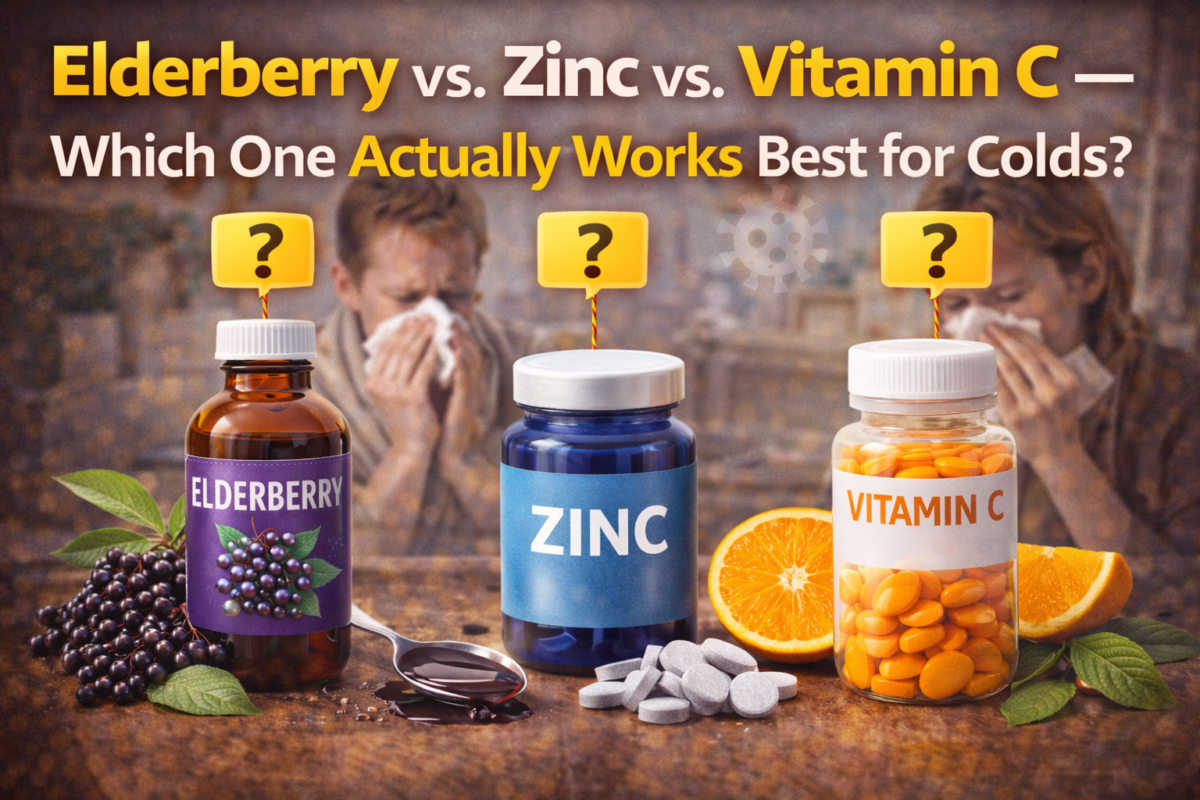
Elderberry — dark berry from the Sambucus nigra plant, concentrated in anthocyanins. Appears to work primarily by blocking viruses from entering cells and stimulating cytokine production. Works on the front end of illness.
Zinc — essential mineral your body can’t produce on its own. Involved in hundreds of enzymatic processes. In the context of colds, it appears to interfere with rhinovirus replication and reduce the duration of symptoms. Also works best early.
Vitamin C — water-soluble antioxidant, essential for immune cell function. Doesn’t prevent colds in most people under normal circumstances, but may reduce severity and duration when taken consistently or in high doses at onset.
They’re not interchangeable. They’re not even doing the same job.



The Research: What Each One Actually Does
Elderberry
The evidence for elderberry in colds and flu is more robust than most people realize — and more honest practitioners will say stronger than the evidence for vitamin C as a treatment.
The landmark 2004 study in the Journal of International Medical Research showed flu patients taking elderberry extract recovered four days faster than the placebo group. A 2016 study on air travelers found elderberry supplementation reduced cold duration by two days and severity significantly. A 2019 meta-analysis in Complementary Therapies in Medicine reviewed the accumulated evidence and concluded elderberry substantially reduced upper respiratory symptoms.
The mechanism is specific: elderberry’s anthocyanins appear to bind to viral particles and block cell entry, while also triggering cytokine release that helps your immune system coordinate a faster response. It’s not vaguely “boosting immunity” — it’s interfering with viral replication at the point of entry.
Best used: at the absolute first sign of symptoms. The earlier the better. For the full breakdown on elderberry’s effectiveness, this covers it in depth: does elderberry really work for colds and flu.
Zinc
Zinc has the strongest evidence base of the three for actually shortening cold duration — when used correctly. That last part is critical.
A Cochrane review — the gold standard of meta-analyses — found that zinc lozenges or syrup started within 24 hours of symptom onset reduced cold duration by about one day. Other studies have shown reductions of up to 40% in duration with proper zinc lozenge use.
The catch: it has to be zinc acetate or zinc gluconate in lozenge form, dissolved slowly in the mouth. Pills and capsules don’t work the same way because the zinc needs to come into contact with the mucous membranes in your throat where rhinovirus replicates. Swallowing a zinc tablet sends it to your stomach, not your throat.
The other catch: zinc at high doses causes nausea and interferes with copper absorption long-term. It’s a short-term therapeutic tool, not a daily supplement.
Best used: within the first 24 hours of cold symptoms, as lozenges dissolved slowly in the mouth. Not for ongoing daily use.
Vitamin C
Vitamin C is the most popular immune supplement in the world and also the most misunderstood.
The research is fairly clear at this point: for the average healthy adult, taking vitamin C does not prevent colds. The famous Linus Pauling claims from the 1970s haven’t held up under rigorous study.
Where vitamin C does show benefit: in people under extreme physical stress (marathon runners, soldiers in cold climates), regular supplementation does reduce cold incidence significantly. For everyone else, the evidence suggests it may modestly reduce cold duration — by roughly half a day to a day — when taken consistently, not just when you feel sick.
High-dose vitamin C at cold onset (1,000–2,000mg) is a popular strategy and there’s some evidence supporting it, but the effect size is smaller than either elderberry or zinc for most people.
The upside of vitamin C: it’s extremely safe, cheap, and supports a wide range of immune functions beyond just fighting colds. It’s a good daily baseline, not a powerful acute treatment.
Best used: as a consistent daily supplement year-round for baseline immune support. Less impactful as a last-minute cold remedy than the other two.
Head-to-Head: When to Use Each One
Situation Best Choice Cold just starting (first 12 hours) Zinc + Elderberry together Flu symptoms coming on fast Elderberry first Daily prevention through cold season Vitamin C daily, Elderberry daily You forgot and you’re on day 3 Vitamin C for comfort, zinc may still help slightly Kids who won’t take zinc lozenges Elderberry — much easier to administer Pregnant and cautious Vitamin C and zinc are safer bets Traveling and want prevention Elderberry has the best travel study data


Can You Take All Three Together?
Yes, and a lot of people do. There are no known negative interactions between elderberry, zinc, and vitamin C. They work through different mechanisms so they’re not redundant — they’re complementary.
A reasonable cold-season stack for an adult:
- Vitamin C 500–1,000mg daily as a baseline
- Elderberry syrup or gummies daily during cold and flu season
- Zinc lozenges added within the first 24 hours of any cold symptoms, for 5–7 days maximum
Don’t take zinc lozenges long-term. That’s the one hard rule here.
For elderberry dosing specifically — both maintenance and therapeutic — this covers it well: what is the ideal elderberry dosage for adults.
What About Echinacea? And Everything Else?
Since you’re here doing the research, a quick word on the other usual suspects:
Echinacea — mixed evidence. Some studies show modest benefit, others show none. Less consistent than elderberry or zinc in the research. Not harmful, but not the first thing I’d reach for.
Garlic — genuinely antimicrobial properties, some evidence for cold prevention. Hard to take in therapeutic amounts without consequences for your social life.
Oscillococcinum — a popular homeopathic flu remedy. The evidence is not there. Skip it.
NyQuil and similar OTC cold medicines — treat symptoms but don’t shorten duration or fight the underlying virus. Useful for getting through a rough night, not for recovery.
The Gut Connection Nobody Talks About
Here’s something worth knowing regardless of which supplement you choose: your immune system doesn’t live in a bottle. Over 70% of it lives in your gut, and if your gut health is compromised — from antibiotics, poor diet, chronic stress — no supplement stack is going to fully compensate.
The connection between gut bacteria and immune function is real and well documented. If you’re getting sick constantly despite taking every supplement on this list, that’s where to look.
The Practical Answer
Stop treating these as competitors and start treating them as tools with different jobs.
Vitamin C is your year-round baseline. Cheap, safe, broadly supportive. Take it daily and don’t expect it to rescue you mid-cold.
Elderberry is your early-warning response. The moment you feel something coming — scratchy throat, unusual fatigue, that particular heaviness behind your eyes — start it immediately. Keep it on hand so you actually can. Daily use through cold season is also a solid preventive strategy. If you’re not sure where to start with elderberry, this daily immune routine is a practical reference.
Zinc is your acute intervention. First 24 hours, lozenges only, dissolved slowly. Don’t take it longer than a week. It’s a short game tool, not a long game one.
Use all three intelligently and you’ve got a better cold-fighting toolkit than anything the pharmacy shelf is actually advertising.



About the Author
Marcus Webb is a health science writer with a background in nutritional biochemistry and over a decade of experience translating clinical research into plain-language content. He has written for several natural health publications and contributes regularly to ElderberryPro.com. He is not a physician and nothing here should be taken as medical advice — but he reads the actual studies so you don’t have to.
As an Amazon Associate we earn from qualifying purchases through some links in our articles.