
Elderberry has a strong safety record. That’s not marketing language — it’s a fair summary of decades of widespread use and the clinical research that exists.
But “strong safety record” doesn’t mean zero side effects, and anyone telling you that elderberry is completely without risk in every situation for every person isn’t being straight with you.
Some people do experience side effects. There are specific populations who should be careful or avoid it entirely. There are interactions worth knowing about. And there’s one situation where elderberry can make you genuinely sick — not because the supplement is dangerous, but because of how it’s prepared.
This covers all of it. The real picture, without either minimizing legitimate concerns or blowing minor ones out of proportion.
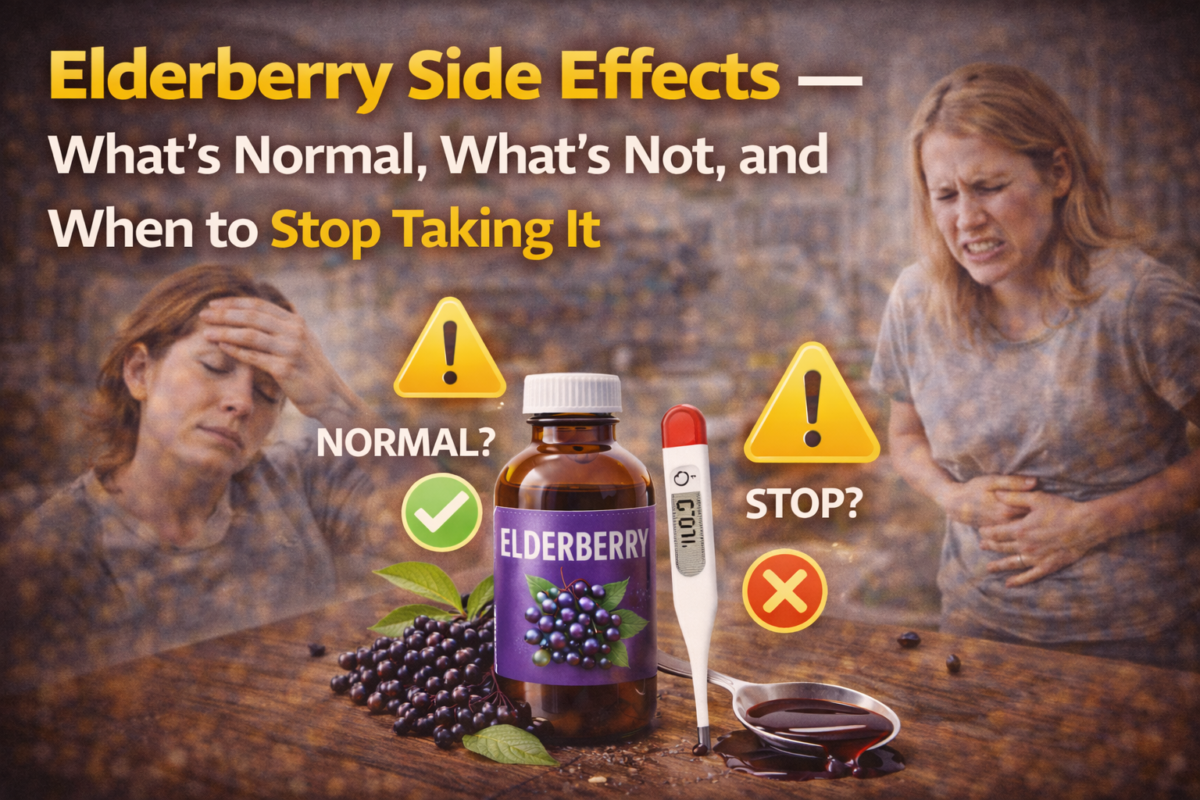


The Most Common Side Effects (And Why They Happen)
Digestive Upset — Nausea, Stomach Cramping, Diarrhea
This is the most frequently reported side effect, and it’s almost always dose-related or related to taking elderberry on an empty stomach.
Elderberry — particularly in concentrated syrup or extract form — is potent. The same compounds that make it effective can irritate the digestive lining in some people, especially at therapeutic doses or when the stomach is empty. The result is nausea, a crampy feeling in the upper abdomen, or loose stools.
This is not dangerous. It’s uncomfortable, and it’s your body telling you to adjust how you’re taking it.
How to fix it:
- Take elderberry with food rather than on an empty stomach
- Reduce your dose temporarily and build up more gradually
- Switch forms — some people who can’t tolerate concentrated syrup do fine with gummies or tea, which are gentler
- If you’re at therapeutic dosing (multiple times per day), spreading doses out more evenly through the day helps
If stomach discomfort is your primary concern, this goes deeper on the specific causes and solutions: stomach pain after elderberry — here’s what might be happening.
Headache
A small number of people report mild headaches after taking elderberry, particularly when starting out. This is likely related to elderberry’s effect on cytokine levels — the same immune signaling that makes it useful can cause mild inflammatory symptoms in some people as the body adjusts.
This typically resolves within a few days of consistent use. If it doesn’t, it’s worth trying a lower dose to start.
Allergic Reactions
True elderberry allergies exist but are uncommon. Symptoms of an allergic reaction include hives, itching, swelling, or — in rare and severe cases — difficulty breathing.
Elderberry is in the Adoxaceae plant family. People with known sensitivities to plants in related families may have a higher risk of cross-reactivity, though this is not well documented in the literature.
More commonly, allergic-type reactions to elderberry products are actually reactions to other ingredients — honey, added flavorings, fillers, or preservatives in commercial products. If you suspect an allergic reaction, check the full ingredient list before assuming elderberry itself is the culprit.
If you experience any throat tightening, difficulty breathing, or widespread hives after taking elderberry, stop immediately and seek medical attention. This applies to any supplement.



The Serious Concern: Raw and Undercooked Elderberries
This is the one that actually warrants real caution, and it’s worth understanding clearly.
Raw elderberries — and the leaves, bark, roots, and seeds of the elderberry plant — contain cyanogenic glycosides, specifically sambunigrin. When these compounds are metabolized, they can produce hydrogen cyanide. The result of eating raw or undercooked elderberries is typically rapid-onset nausea, vomiting, stomach cramping, and diarrhea. In significant quantities, more serious toxicity is possible.
Cooking destroys these compounds completely. All properly prepared elderberry products — commercial syrups, extracts, gummies, capsules — have been processed in ways that eliminate this risk. Homemade elderberry syrup that has been properly cooked at sufficient temperature is safe.
The risk is specific and avoidable: eating raw berries straight from the bush, eating undercooked berries, or consuming parts of the plant other than the ripe berry.
If you’re foraging, growing your own, or making anything from scratch, this is essential reading before you start: never eat elderberries until you read this.
Who Should Be Careful or Avoid Elderberry
People With Autoimmune Conditions
This is the most important contraindication to understand, and the one most commonly overlooked.
Elderberry stimulates immune function — specifically, it increases cytokine production and enhances immune cell activity. For healthy people, this is the desired effect. For people whose immune systems are already overactive — as in autoimmune conditions — this stimulation can theoretically worsen symptoms or trigger flares.
The autoimmune conditions most relevant to this concern include:
- Rheumatoid arthritis
- Lupus (SLE)
- Multiple sclerosis
- Psoriasis
- Inflammatory bowel disease (Crohn’s, ulcerative colitis)
- Hashimoto’s thyroiditis
- Type 1 diabetes
The evidence here is theoretical rather than based on documented clinical cases — meaning this concern comes from understanding how elderberry works mechanically, not from a documented pattern of people with lupus getting worse after taking elderberry syrup. But the theoretical concern is legitimate enough that most integrative practitioners recommend caution, and most mainstream physicians recommend avoiding it entirely for patients with active autoimmune disease.
If you have an autoimmune condition and want to use elderberry, have that conversation with your rheumatologist or specialist. Don’t just proceed on the basis that it’s “natural.”
People on Immunosuppressant Medications
The same logic applies, but more directly. If you’re taking medication specifically to suppress immune function — post-organ-transplant patients, people managing severe autoimmune disease with biologics like methotrexate, azathioprine, or TNF inhibitors — elderberry works against that goal by stimulating the immune response you’re pharmacologically trying to dampen.
This is a genuine interaction concern, not a theoretical one. Avoid elderberry if you’re on immunosuppressants unless your prescriber has specifically cleared it.
Pregnant Women — Especially First Trimester
The honest answer on elderberry during pregnancy is that we don’t have clinical data because pregnant women are excluded from most clinical trials. What we do have is: no documented cases of harm, a theoretical concern about immune stimulation during pregnancy, and a well-established medical principle of avoiding anything non-essential during the first trimester.
Most integrative practitioners land in the same place: first trimester, avoid it. Second and third trimester, low-dose or occasional use is probably fine but worth discussing with your OB or midwife. Concentrated supplements throughout pregnancy are more reason for caution than occasional elderberry tea.
The full nuanced breakdown on this specific situation: elderberry and pregnancy — is it safe and should you take it.
Infants Under One Year
Not because of elderberry specifically, but because most elderberry syrups are made with raw honey, which carries a risk of infant botulism for babies under 12 months. This is a honey issue, not an elderberry issue — but since the two are so commonly combined in syrup form, it’s worth calling out explicitly.
Honey-free elderberry products are available and considered appropriate for infants over six months in some traditions, but check with your pediatrician before giving any supplement to a baby.
People With Diabetes
Elderberry itself is not contraindicated in diabetes, but many commercial elderberry products — particularly gummies and syrups — contain significant amounts of added sugar. At therapeutic doses (multiple servings per day), this can affect blood sugar in people who are managing diabetes carefully.
Read labels. Opt for lower-sugar formulations. Homemade elderberry syrup sweetened with a small amount of honey gives you more control than commercial products.
Elderberry may also have mild blood sugar-lowering effects based on some preliminary research. For most people this is a minor point, but for people on diabetes medications it’s worth monitoring and discussing with your provider.



Drug Interactions Worth Knowing About
Elderberry has a relatively clean interaction profile — it doesn’t have the extensive drug interaction list that something like St. John’s Wort does. But there are a few categories worth knowing:
Immunosuppressants
Already covered above, but worth repeating in this context: elderberry’s immune-stimulating effects work against the goal of immunosuppressive medications. This is the most clinically significant interaction concern.
Diuretics
Some sources flag a potential interaction between elderberry and diuretic medications (water pills). Elderberry has mild diuretic properties of its own — historically it’s been used to promote urination. The concern is additive effect causing excess fluid loss. This is theoretical and not well documented at normal supplement doses, but if you’re on a prescription diuretic, it’s worth mentioning elderberry to your prescriber.
Diabetes Medications
As noted above, if elderberry has even a mild blood-sugar-lowering effect and you’re on medication that also lowers blood sugar, the additive effect could theoretically cause blood sugar to go lower than intended. Monitor accordingly and discuss with your doctor.
Laxatives
Elderberry has mild laxative properties. Combined with prescription or over-the-counter laxatives, this could cause more significant digestive effects than either alone. Not dangerous in most cases, but worth knowing about.
Chemotherapy
There is theoretical concern — and in some cases active oncology guidance against — using elderberry during chemotherapy. Some chemotherapy regimens rely on a specific immune environment, and immune stimulation from elderberry could theoretically interfere. If you’re undergoing cancer treatment, this is absolutely a conversation to have with your oncologist before adding any supplement.


Elderberry and the Immune System: The Cytokine Storm Question
You may have seen claims during the COVID-19 pandemic that elderberry could trigger a “cytokine storm” — an overwhelming immune response that causes severe illness. This concern led to widespread confusion and some people stopping elderberry during pandemic conditions.
Here’s the honest assessment: the cytokine storm concern as applied to elderberry is almost certainly overblown.
A cytokine storm is a severe, dysregulated, whole-body immune response associated with serious infections and certain medical conditions. The cytokine stimulation from elderberry is mild, localized, and self-limiting — the same basic mechanism that most foods and supplements with any immune-modulating properties produce.
The claim that elderberry could trigger a cytokine storm in the context of a respiratory viral infection was theoretical, was not supported by clinical evidence, and was disputed by most herbalists and integrative practitioners who actually work with elderberry. The research specifically on elderberry and COVID-19 showed no evidence of harm.
This doesn’t mean the underlying biology is irrelevant for the autoimmune populations discussed above. But for healthy people using elderberry during a respiratory illness, the cytokine storm concern is not supported by evidence.
Long-Term Use: Is It Safe to Take Elderberry Every Day Indefinitely?
This is a question without a perfectly clean answer, because long-term safety studies on daily elderberry use over years don’t exist. What we have is:
- Decades of widespread traditional use without documented harm patterns
- Short-to-medium term clinical studies showing no serious adverse effects
- Theoretical concern about chronic immune stimulation over very long periods
The practical consensus among integrative practitioners is that daily elderberry use through cold and flu season — roughly six months — is appropriate and well within documented safety. Year-round use without breaks is where the evidence thins out and where a more cautious approach makes sense.
Many practitioners recommend taking a break from elderberry in summer — two to three months off — simply as a conservative measure given the theoretical concern, not because of documented problems. It’s a reasonable hedge.

Side Effects in Specific Populations
Elderberry Side Effects in Women
No specific side effects are unique to women outside of the pregnancy considerations already covered. Women with autoimmune conditions — which disproportionately affect women — should apply the same caution described above.
Some women report elderberry seems to affect their cycle or cause mild hormonal symptoms. This is anecdotal and there is no established mechanism for elderberry affecting sex hormones. It may reflect digestive side effects or simply coincidental timing. If you notice a consistent pattern, it’s worth noting and discussing with your doctor.
Elderberry Side Effects in Seniors
Seniors over 65 generally respond to elderberry the same way younger adults do. Immune function naturally declines with age, making elderberry support potentially more valuable, not less. Standard adult dosing applies.
The key consideration for seniors is polypharmacy — the reality that many older adults take multiple medications simultaneously. With more medications in the picture, the interaction considerations above (immunosuppressants, diuretics, diabetes medications) become more relevant to check against. A quick review of your medication list with your pharmacist before starting elderberry is a reasonable step.
Elderberry and Thyroid Conditions
Hashimoto’s thyroiditis — the most common cause of hypothyroidism — is an autoimmune condition, so the autoimmune caution applies. For non-autoimmune thyroid conditions (standard hypothyroidism, hyperthyroidism not driven by autoimmunity), there is no established interaction between elderberry and thyroid function or thyroid medications. If you have any thyroid condition and are uncertain, check with your endocrinologist.



When to Actually Stop Taking Elderberry
Here’s a practical framework:
Stop and consult a doctor if:
- You experience signs of an allergic reaction (hives, swelling, difficulty breathing)
- You develop persistent nausea or digestive symptoms that don’t resolve with dose reduction
- You’re diagnosed with an autoimmune condition or starting immunosuppressant therapy
- You become pregnant and want to take the conservative approach
- Your doctor identifies a specific reason related to your health history
Reduce your dose if:
- Mild nausea or stomach upset that started with elderberry
- Headache in the first few days of use
- Loose stools at therapeutic dosing levels
Don’t stop because of:
- Vague concern about “too much of a good thing” without specific symptoms
- The cytokine storm claims (for healthy adults without autoimmune conditions)
- General internet fear-mongering without cited evidence
The Bottom Line For This Topic
Elderberry is genuinely safe for most healthy adults at appropriate doses. The side effect profile is mild — primarily digestive upset that resolves with dose adjustment — and serious adverse events are rare and almost always tied to raw berry consumption or specific contraindicated populations.
The people who need to be careful are people with autoimmune conditions, people on immunosuppressant medications, and pregnant women in the first trimester. If you fall into one of those categories, talk to your doctor before starting.
For everyone else: understand the difference between properly prepared elderberry products and raw berries, dose appropriately for your goal, take it with food if your stomach is sensitive, and you’re in well-documented safe territory.
For more on how to dose correctly across different forms and goals, the complete guide to elderberry dosage for adults covers everything in one place.

About the Author
Dr. Patricia Nguyen is a board-certified internal medicine physician with additional training in integrative medicine from the University of Arizona Center for Integrative Medicine. She has spent eighteen years in clinical practice and writes about evidence-based natural health at ElderberryPro.com with a particular focus on helping patients separate well-supported guidance from wellness industry noise. Nothing in her writing constitutes personal medical advice — always work with your own provider for decisions specific to your health history.
As an Amazon Associate we earn from qualifying purchases through some links in our articles.